Hey there! As a ball bearing supplier, I've seen firsthand how these little components can make a huge difference in the performance of a rotating shaft. In this blog, I'm gonna break down exactly how ball bearings affect that performance and why they're so crucial.
Let's start with the basics. A ball bearing is a type of rolling - element bearing that uses balls to maintain the separation between the bearing races. It's designed to reduce rotational friction and support radial and axial loads. When it comes to a rotating shaft, these functions have far - reaching impacts.
1. Reducing Friction
Friction is the enemy of any rotating system. When a shaft rotates without proper support, it rubs against its surrounding components, creating heat and wearing down the surfaces. This not only shortens the lifespan of the shaft but also reduces the efficiency of the entire system.
Ball bearings are a game - changer here. The balls inside the bearing roll between the inner and outer races, which significantly reduces the friction compared to a sliding contact. This means that the shaft can rotate more freely, using less energy. For example, in an electric motor, less friction means less power is wasted as heat, and the motor can operate more efficiently.


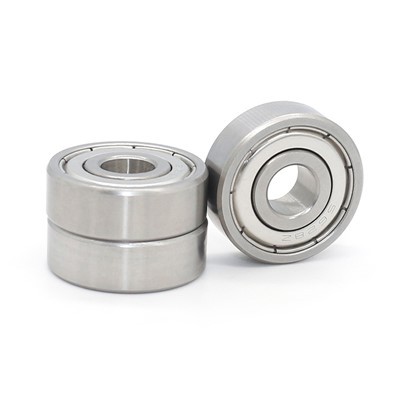
Our Low Noise Motor Bearing S628ZZ is a great example. It's specifically designed to minimize friction, which not only improves the efficiency of the motor but also reduces noise. The low - friction design allows the motor shaft to rotate smoothly, making it ideal for applications where quiet operation is essential, like in home appliances or precision instruments.
2. Handling Loads
Rotating shafts often have to deal with different types of loads, including radial loads (perpendicular to the shaft) and axial loads (parallel to the shaft). Ball bearings are engineered to handle these loads effectively.
Radial loads are common in applications like conveyor belts or fans. The ball bearings distribute the weight evenly across the balls, preventing excessive stress on any one point of the shaft. This helps to maintain the straightness of the shaft and ensures that it rotates without wobbling.
Axial loads, on the other hand, are present in things like pumps or screw conveyors. Some ball bearings are designed to handle both radial and axial loads simultaneously. For instance, our 698ZZ Industrial Deep Groove Ball Bearing | High Speed, High Precision, Heat & Corrosion Resistant, Full OEM ODM Custom Service | BLH can handle a combination of these loads. Its high - precision design and ability to resist heat and corrosion make it suitable for industrial applications where shafts are under heavy loads and harsh conditions.
3. Enhancing Precision
In many applications, precision is key. Whether it's in a machine tool or a medical device, the rotating shaft needs to rotate with a high degree of accuracy. Ball bearings play a crucial role in achieving this.
The design of the ball bearing ensures that the inner and outer races are precisely aligned. This alignment allows the shaft to rotate within a very small tolerance. The balls themselves are manufactured to extremely tight specifications, which further contributes to the overall precision.
Our Thin - walled Deep Groove Ball Bearings6904ZZ are known for their high precision. The thin - walled design allows for a more compact installation, while still maintaining the accuracy required for high - performance applications. This makes them perfect for use in equipment where space is limited but precision cannot be compromised.
4. Increasing Speed
Ball bearings also have a significant impact on the maximum speed at which a shaft can rotate. The low - friction design of ball bearings allows the shaft to spin at higher speeds without overheating or excessive wear.
When a shaft rotates at high speeds, the centrifugal force on the balls and the races can be quite large. High - quality ball bearings are designed to withstand these forces. They use special materials and lubricants to ensure smooth operation even at high rotational speeds.
The 6300 Series Deep Groove Ball Bearings are engineered for high - speed applications. Their robust construction and optimized design make them capable of handling the demands of high - speed rotating shafts, whether it's in a turbocharger or a high - speed spindle.
5. Improving Durability
Durability is another important aspect of a rotating shaft's performance. A shaft that fails prematurely can cause costly downtime and repairs. Ball bearings can significantly extend the lifespan of a rotating shaft.
By reducing friction and evenly distributing loads, ball bearings minimize wear and tear on the shaft. They are also designed to withstand harsh operating conditions, such as high temperatures, moisture, and contaminants.
Our 6900 Series Deep Groove Ball Bearings are built to last. They are made from high - quality materials and undergo strict quality control measures. This ensures that they can provide long - term reliable performance in a wide range of applications.
Conclusion
So, as you can see, ball bearings have a profound impact on the performance of a rotating shaft. From reducing friction and handling loads to enhancing precision, increasing speed, and improving durability, they are an essential component in any rotating system.
If you're in the market for high - quality ball bearings for your rotating shaft applications, don't hesitate to reach out. We have a wide range of ball bearings to meet your specific needs, and our team of experts is always ready to assist you in finding the perfect solution. Whether it's for a small - scale project or a large - scale industrial application, we've got you covered. Let's have a chat and see how we can help improve the performance of your rotating shafts.
References
- "Rolling Bearing Analysis" by Tedric A. Harris
- "Mechanical Design Handbook" by Myer Kutz