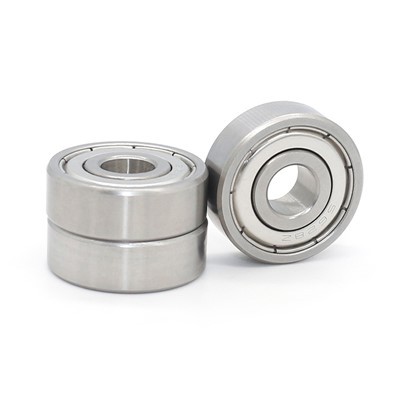
Damping capacity is a critical factor that significantly influences the performance of a screw bearing. As a screw bearing supplier, understanding the relationship between damping capacity and bearing performance is essential for providing high - quality products to our customers.
1. Understanding Damping Capacity
Damping capacity refers to the ability of a material or a system to dissipate energy when it is subjected to vibration or dynamic loading. In the context of screw bearings, damping helps to reduce the amplitude of vibrations, minimize noise, and prevent premature wear and failure.
When a screw bearing is in operation, it experiences various dynamic forces, such as axial and radial loads, as well as rotational forces. These forces can cause vibrations in the bearing and the surrounding components. If the damping capacity is low, these vibrations can build up and lead to several problems. For example, excessive vibrations can cause noise pollution in the working environment, which is not only annoying but can also be a safety hazard in some cases. Moreover, vibrations can accelerate the wear of the bearing components, reducing the bearing's service life and increasing the maintenance costs.
2. Impact on Vibration and Noise Reduction
One of the most significant effects of damping capacity on screw bearing performance is its ability to reduce vibrations and noise. When a bearing has a high damping capacity, it can absorb and dissipate the energy generated by vibrations more effectively. This is achieved through internal friction within the bearing material.
For instance, in a high - precision machinery application where smooth operation is crucial, a screw bearing with good damping characteristics can prevent the transmission of vibrations to the rest of the system. This is particularly important in applications such as CNC machines, where even small vibrations can affect the accuracy of the machining process.
Let's take the example of Screw BearingsS609ZZ. These bearings are designed with materials that have a relatively high damping capacity. As a result, they can effectively reduce the vibrations generated during operation, leading to quieter and more stable performance. This makes them ideal for applications where noise reduction is a priority, such as in medical equipment or laboratory instruments.
3. Influence on Wear and Fatigue Resistance
Damping capacity also plays a vital role in enhancing the wear and fatigue resistance of screw bearings. When a bearing is subjected to cyclic loading, the vibrations can cause stress concentrations at certain points on the bearing surfaces. Over time, these stress concentrations can lead to fatigue cracks and wear, ultimately resulting in bearing failure.
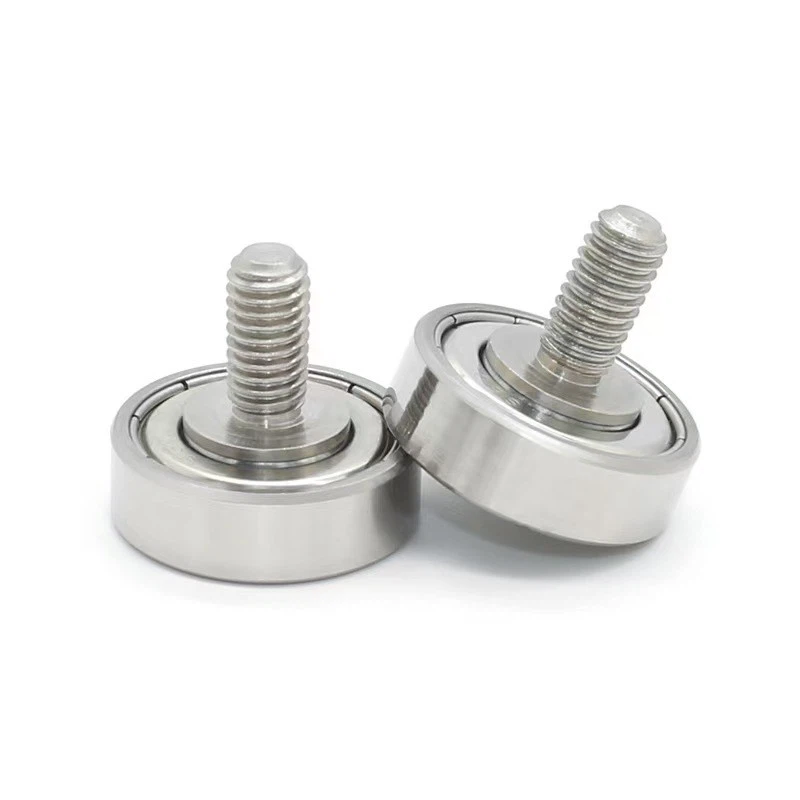
A bearing with high damping capacity can reduce the amplitude of vibrations, which in turn reduces the stress concentrations. By dissipating the energy of the vibrations, the bearing can better withstand the cyclic loading without experiencing premature wear and fatigue. For example, External Threaded Bearing 6002ZZ With Screw is designed to have enhanced damping characteristics. This helps to distribute the load more evenly across the bearing surfaces, reducing the wear and extending the bearing's service life.
In high - speed applications, the importance of damping capacity for wear and fatigue resistance becomes even more evident. At high speeds, the dynamic forces acting on the bearing are much greater, and the vibrations can be more severe. A bearing with poor damping capacity may experience rapid wear and fatigue, leading to frequent replacements and increased downtime. On the other hand, a bearing with high damping capacity can maintain its performance even under high - speed and high - load conditions.
4. Effects on System Stability
The damping capacity of a screw bearing can also affect the stability of the entire system in which it is used. In a mechanical system, the bearing is often a critical component that provides support and guidance for rotating shafts. If the bearing has low damping capacity, the vibrations can cause the shaft to deviate from its intended path, leading to instability in the system.
For example, in a rotating machinery system, such as a pump or a compressor, the stability of the shaft is crucial for efficient operation. A screw bearing with high damping capacity can help to keep the shaft in a stable position by reducing the vibrations. This ensures that the system operates smoothly and efficiently, without any unexpected oscillations or malfunctions.
Screw BearingsS696ZZ are engineered to have excellent damping properties, which contribute to the overall stability of the system. These bearings can effectively absorb the energy of the vibrations, preventing them from causing any significant disturbances in the system.
5. Material and Design Considerations for Damping Capacity
To achieve high damping capacity in screw bearings, the choice of materials and the design of the bearing are crucial. Materials with high internal friction, such as certain types of polymers or composite materials, can be used to increase the damping capacity. These materials can absorb and dissipate the energy of vibrations more effectively than traditional bearing materials like steel.
In addition to the material selection, the design of the bearing can also be optimized to enhance the damping capacity. For example, the internal structure of the bearing can be designed to have a certain amount of flexibility, which allows it to deform slightly under the influence of vibrations and dissipate the energy. The shape and size of the bearing components can also be adjusted to improve the damping characteristics.

6. Conclusion and Call to Action
In conclusion, damping capacity has a profound impact on the performance of screw bearings. It affects vibration and noise reduction, wear and fatigue resistance, and system stability. As a screw bearing supplier, we are committed to providing bearings with high damping capacity to meet the diverse needs of our customers.
Whether you are looking for a bearing for a high - precision application, a high - speed machinery, or a system that requires low noise operation, our range of screw bearings, such as Screw BearingsS609ZZ, External Threaded Bearing 6002ZZ With Screw, and Screw BearingsS696ZZ, can offer the performance and reliability you need.
If you are interested in learning more about our screw bearings or would like to discuss your specific requirements, we encourage you to reach out to us for a procurement discussion. We look forward to working with you to find the best bearing solutions for your applications.
References
- Harris, T. A., & Kotzalas, M. N. (2007). Rolling Bearing Analysis. Wiley.
- Gupta, P. K. (2002). Design of Machine Elements. Pearson Education.