


Yo! As a supplier of plastic ball bearings, I often get asked if plastic ball bearings have a high elongation at break. It's a pretty important question, especially for those who are looking to use these bearings in various applications. So, let's dive right into it.
First off, what's elongation at break? Well, it's a measure of how much a material can stretch before it breaks. In the context of plastic ball bearings, a high elongation at break means the bearing can withstand a fair amount of deformation without snapping. This is super crucial in applications where the bearings might experience some stress or where a bit of flexibility is needed.
Now, plastic ball bearings come in different types, and each type has its own characteristics when it comes to elongation at break. Let's take a look at some common types.
Peek Bearings
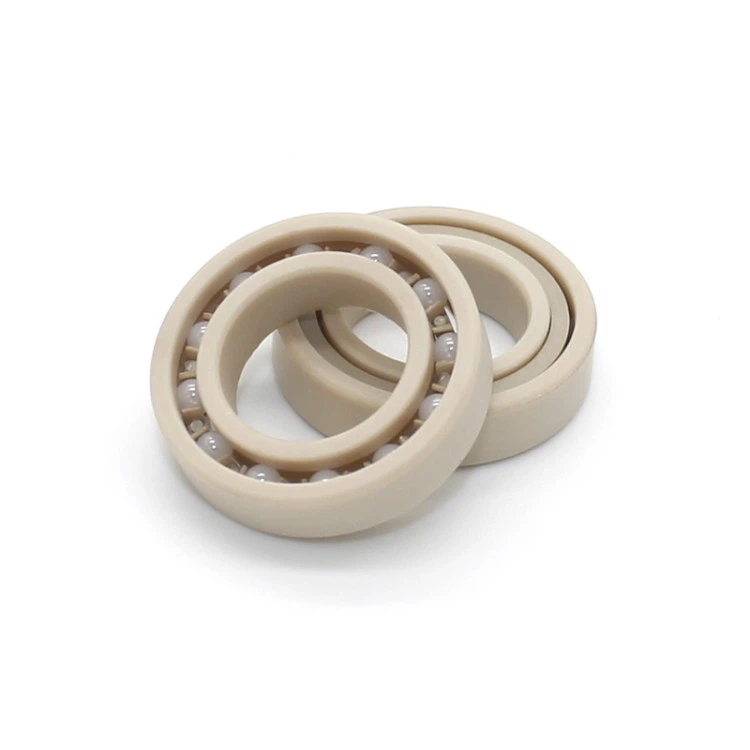
Peek (Polyetheretherketone) bearings are known for their excellent mechanical properties. They're often used in high - performance applications. When it comes to elongation at break, Peek bearings generally have a decent amount of it. Peek is a semi - crystalline thermoplastic, and its molecular structure allows it to stretch to a certain extent before failure.
The elongation at break of Peek can vary depending on factors like the specific grade of Peek used and the manufacturing process. But typically, it can range from around 15% to 50%. This means that Peek bearings can handle some level of stretching or deformation in applications. For example, in some aerospace or automotive applications where there might be vibrations or small amounts of misalignment, Peek bearings can tolerate the stress without breaking easily. If you're interested in Peek bearings, you can check out more details Peek Bearings.
Nylon Bearings
Nylon is another popular material for plastic ball bearings. Nylon bearings are known for their self - lubricating properties and good wear resistance. When it comes to elongation at break, nylon can have a relatively high value.
Nylon has a more flexible molecular structure compared to some other plastics. Depending on the type of nylon (e.g., Nylon 6 or Nylon 66), the elongation at break can be anywhere from 50% to 300%. This high elongation at break makes nylon bearings suitable for applications where there is a need for some flexibility. For instance, in conveyor systems or some consumer products where the bearings might be subject to bending or twisting forces, nylon bearings can perform well. If you want to learn more about nylon bearings, head over to Nylon Bearings.
POM Plastic Bearings
POM (Polyoxymethylene), also known as acetal, is a widely used plastic for ball bearings. POM plastic bearings are valued for their dimensional stability and low friction. However, when it comes to elongation at break, POM has a relatively lower value compared to nylon.
The elongation at break of POM typically ranges from about 15% to 75%. This is still enough for many applications, but it might not be as suitable for situations where a large amount of stretching is expected. POM is more rigid compared to nylon, which gives it good stiffness and precision. It's often used in applications where accurate positioning and low - wear are required, such as in robotics or precision machinery. If you're considering POM plastic bearings, you can find more information here POM Plastic Bearings.
Factors Affecting Elongation at Break
There are several factors that can affect the elongation at break of plastic ball bearings. One of the main factors is the temperature. Most plastics become more flexible at higher temperatures, which means their elongation at break can increase. For example, a nylon bearing might have a higher elongation at break at 60°C compared to at room temperature.
The manufacturing process also plays a role. If the plastic is molded or machined incorrectly, it can introduce internal stresses in the bearing, which can reduce its elongation at break. Additionally, additives can be used to modify the elongation at break. For example, adding glass fibers to a plastic can increase its stiffness but decrease its elongation at break.
Why Elongation at Break Matters
Understanding the elongation at break of plastic ball bearings is crucial for choosing the right bearing for your application. If you're working on a project where the bearings will be subject to bending or stretching forces, you'll want to choose a bearing with a high elongation at break, like nylon. On the other hand, if you need a bearing for a precision application where dimensional stability is key, a POM bearing might be a better choice, even though it has a lower elongation at break.
In some cases, a high elongation at break can also mean better shock absorption. When a bearing can stretch, it can absorb some of the energy from impacts or sudden loads, which can prevent damage to the bearing and the surrounding components.

Conclusion
So, do plastic ball bearings have a high elongation at break? Well, it depends on the type of plastic. Nylon bearings generally have a high elongation at break, making them suitable for applications where flexibility is needed. Peek bearings have a decent amount of elongation at break, which is useful in high - performance applications. POM plastic bearings have a relatively lower elongation at break but offer other advantages like dimensional stability.
If you're in the market for plastic ball bearings and need to figure out which type is best for your application based on elongation at break or other properties, don't hesitate to reach out. We're here to help you make the right choice. Whether you need a bearing with high flexibility or one that offers precision, we've got you covered. Let's have a chat and see how we can meet your needs.
References
- "Plastic Materials in Engineering" by John A. Brydson
- "Handbook of Plastics, Elastomers, and Composites" by Charles A. Harper


