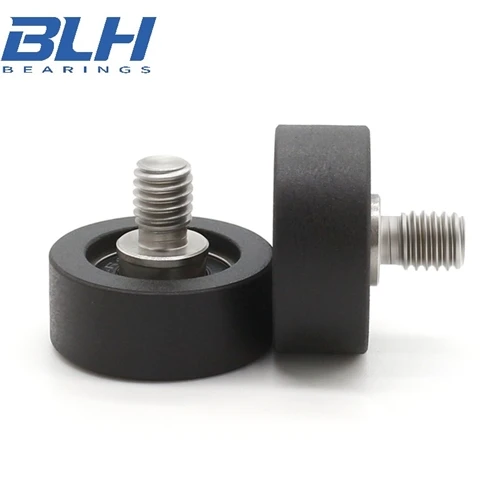
Dimensional accuracy standards.
1. Diameter tolerance: The diameter tolerance of general industrial coated rollers is controlled within ± 0.05mm ± 0.1mm. For example, in the production line of electronic devices, the rubber roller used for conveying needs to strictly control the diameter tolerance within this range to ensure smooth material transportation. In high-precision application scenarios, such as encapsulation rollers in semiconductor manufacturing equipment, the diameter tolerance can be accurate to ± 0.01mm ± 0.03mm.
2. Length tolerance: The length tolerance is usually within ± 0.1mm ± 0.3mm. Taking the adhesive roller in printing machinery as an example, a suitable length tolerance can ensure even ink transfer during the printing process and avoid uneven printing.
Hardness standard.
1. Shore hardness: There are significant differences in the hardness requirements for rubber coated rollers in different application scenarios. In textile machinery, the Shore hardness of the coated roller in contact with the fabric is usually 40 60HA, which can avoid damage to the fabric during transportation. On some heavy-duty transportation equipment, the rubber coated rollers have a Shore hardness of up to 70 90HA to withstand high pressure.
2. Hardness uniformity: The overall hardness uniformity deviation of the rubber coated roller should be controlled within ± 3HA. Uneven hardness can cause uneven stress on the rollers during operation, affecting the normal operation of the equipment and shortening the service life of the rollers.

Material standards.
1. Rubber wrapping materials: Common rubber wrapping materials include polyurethane, nitrile rubber, silicone, etc. Polyurethane coating has the characteristics of high strength and high wear resistance, with a tensile strength of up to 20 50 MPa and a fracture elongation of 300% to 800%. It is suitable for occasions that require high wear resistance, such as mining conveying equipment. Nitrile rubber coating has good oil resistance and a volume change rate of no more than ± 5% in an oil resistant environment. It is commonly used for equipment rollers that come into contact with oil products. Silicone encapsulation has good high temperature resistance and aging resistance, and can be used for a long time in environments of 50 ℃ to 200 ℃. It is commonly used in fields such as food processing and medical equipment that require high hygiene and temperature.
2. Core shaft material: The core shaft is generally made of high-quality carbon steel or alloy steel. The carbon content of high-quality carbon steel is between 0.1% and 0.6%, with good comprehensive mechanical properties and a tensile strength of 375 600 MPa. Alloy steel is added according to different alloy elements to have higher strength and toughness, and is commonly used for the core shaft of rubber coated rollers that can withstand heavy loads.
Surface roughness standard.
1. Surface roughness of rollers: The surface roughness Ra of ordinary industrial coated rollers is generally controlled at 0.8 μ m and 3.2 μ m. In some optical equipment and precision instruments that require high surface quality, the surface roughness Ra of the coated roller can reach 0.2 μ m 0.4 μ m to ensure that there are no scratches when in contact with precision components and to ensure equipment accuracy.
Static balance standard.
1. Unbalance: For rubber coated rollers with low speeds (less than 1000r/min), the allowable value of unbalance is generally 50 100g · mm. When the speed is high (greater than 3000r/min), the unbalance should be strictly controlled within 10-30g · mm to reduce vibration and noise during equipment operation, improve equipment stability and service life.

Important Conclusions
1. For general industrial rubber-covered rollers, the diameter tolerance is typically controlled within ±0.05 mm to ±0.1 mm; for high-precision applications, such as semiconductor manufacturing equipment, this can be tightened to ±0.01 mm to ±0.03 mm.
2. The length tolerance for rubber-covered rollers is generally between ±0.1 mm and ±0.3 mm; in printing machinery, this precision is essential to ensure uniform ink transfer.
3. In textile machinery, rubber-covered rollers typically have a Shore A hardness of 40 to 60 HA to prevent damage to fabrics, while rollers for heavy-duty transport equipment may reach 70 to 90 HA to withstand higher pressures.
4. The deviation in overall hardness uniformity for rubber-covered rollers should be kept within ±3 HA; inconsistent hardness can negatively affect equipment operation and service life.
5. Polyurethane coatings offer a tensile strength of 20 to 50 MPa and an elongation at break of 300% to 800%, making them suitable for high-wear environments, such as mining conveyor equipment.
6. Nitrile rubber (NBR) coatings exhibit a volume change of no more than ±5% in oil-rich environments, making them ideal for rollers that come into contact with oils.
7. Silicone rubber coatings can withstand long-term use in temperatures ranging from -50°C to 200°C, making them suitable for applications requiring high hygiene standards or resistance to high temperatures, such as in food processing or medical equipment.
8. High-quality carbon steel cores typically have a carbon content of 0.1% to 0.6% and a tensile strength of 375 to 600 MPa, while alloy steel cores are used for heavy-duty rubber-covered rollers.
9. The surface roughness (Ra) of standard industrial rubber-covered rollers ranges from 0.8 μm to 3.2 μm, whereas high-precision applications, such as those in optical equipment, require a range of 0.2 μm to 0.4 μm.
10. For low-speed rubber-covered rollers, an unbalance of 50 to 100 g·mm is permissible; for high-speed applications (>3000 rpm), this must be controlled to within 10 to 30 g·mm to minimize vibration and noise.
BLH Bearing | Dongguan Good Power Bearing Co., Ltd., Founded in 2005, we are a professional transmission module manufacturer that integrates research and development, production, sales, and service. Obtained ISO9001 and ISO14001 international quality and environmental management system certification in 2008. Our products include precision bearings, steel bearings, stainless steel bearings, engineering plastic ceramic bearings, and special customized non-standard bearings, irregular shafts, bearing gears, bearing seats, etc. We specialize in manufacturing, providing services, and solutions for transmission modules centered on bearings. We have new production testing equipment, first-class production and research and development management, and give back to all customers with excellent quality and high-quality service.
For more tolerance standards for bearings and pulleys, please contact us. Thank you.