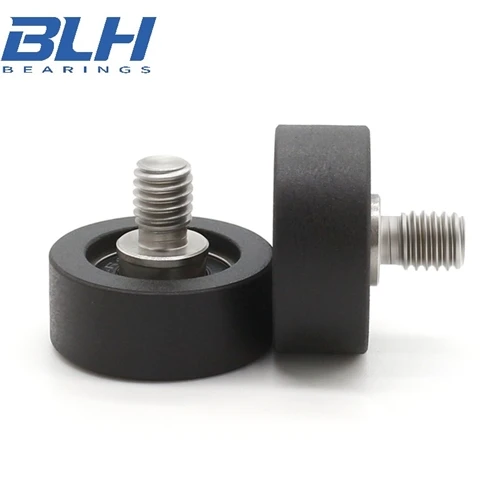
Injection Molding Process for POM Encapsulated Roller Bearing
1. Mold Design
The mold design is crucial to ensure the precise dimension and surface finish of the POM encapsulated roller bearing. The mold cavity must be designed to accommodate the specific bearing dimensions and tolerances, including the outer ring, inner ring, and rolling elements, while accurately locating the pre-assembled steel core.
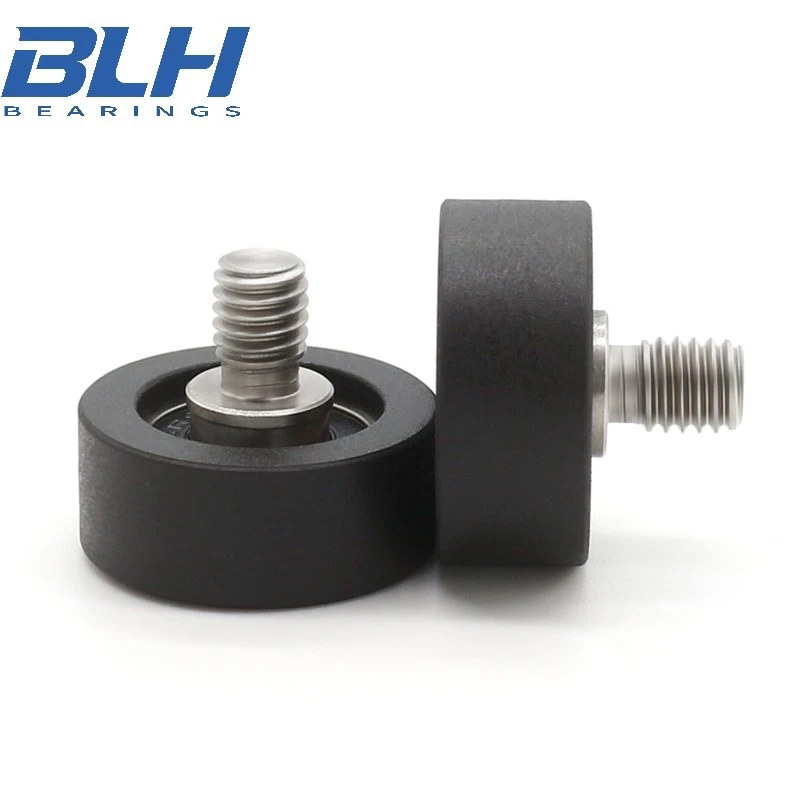
Special attention is given to products such as the plastic coated bearing roller with threaded studand threaded bolt roller bearing wheel, where the mold incorporates precise positioning for the threaded stud or bolt to maintain concentricity and thread integrity after overmolding. Gate placement, cooling channels, and ejection mechanisms are optimized to avoid damage to the threaded features and to achieve a clean surface finish on functional rolling surfaces.
2. Material Selection
The choice of POM material is essential for the performance and durability of the bearing. POM is a thermoplastic material known for its high strength, stiffness, and low friction. The melt flow index (MFI) of the POM should be considered to ensure proper flowability during injection molding.
Depending on application requirements, material variants include:
Standard POM for general-purpose POM nylon pulley wheel roller with screw.
Higher-wear grades or hybrid systems when customers request polyurethane coated bearing with screw bolt for enhanced abrasion resistance in demanding environments.
Additives such as PTFE or glass fiber may be incorporated to further improve friction and load-bearing characteristics.
3. Injection Molding Process
The injection molding process involves several steps:
Clamping: The two halves of the mold are clamped together to create a sealed cavity, securely holding the metal bearing insert and any threaded stud.
Injection: Molten POM is injected into the mold cavity using a high-pressure injection machine, forming a uniform encapsulation around the bearing and threaded features.
Cooling: The molten POM solidifies and cools within the mold under controlled temperature to minimize residual stress and maintain dimensional accuracy of the threaded bolt or stud.
Ejection: Once the POM has solidified, the mold opens, and the finished part-such as an M8 screw thread bearing pulley roller(-is ejected without damaging the thread or rolling surface.
This process is widely used to produce precision components listed in the BLH bearings catalog, ensuring consistent quality across different sizes and configurations.
4. Post-Processing
After injection molding, additional processing steps may be required:
Deflashing: Removing any excess material from the surface of the bearing and around the threaded stud.
Annealing: Heating the bearing to a specific temperature to relieve internal stresses and improve mechanical properties, particularly important for high-precision micro guide pulley wheel with stud
5. Typical Applications
These POM-encapsulated products are widely applied in both industrial and consumer fields, corresponding to high-search-volume keywords:
Sliding door track guide roller- high-volume production for residential and light-industrial sliding systems.
Conveyor engineering plastic flat bearings- used as support and guide rollers in conveyor systems.
Drawer roller pulley bearing replacement- common spare parts for furniture and office equipment.
Micro guide pulley wheel with stud- frequently specified in automation equipment, printers, and 3D printers.
By integrating precise mold design, appropriate POM (or POM/PU hybrid) material selection, and controlled injection parameters, manufacturers can reliably produce high-quality plastic coated bearing roller with threaded stud, / threaded bolt roller bearing wheel, and related products that meet both domestic and international market demands.
6. About Us:
1. Established in 2005, BLH Bearings is a professional manufacturer of power transmission components, integrating production, R&D, and sales.
2. The company obtained ISO 9001 and ISO 14001 international quality management system certifications in 2008.
3. We utilize state-of-the-art production and testing equipment, employ top-tier management for production and R&D, and are committed to providing customers with exceptional quality and service.
4. Renowned for superior performance and continuous technological innovation, our products are highly favored by a wide range of consumers and manufacturing enterprises.