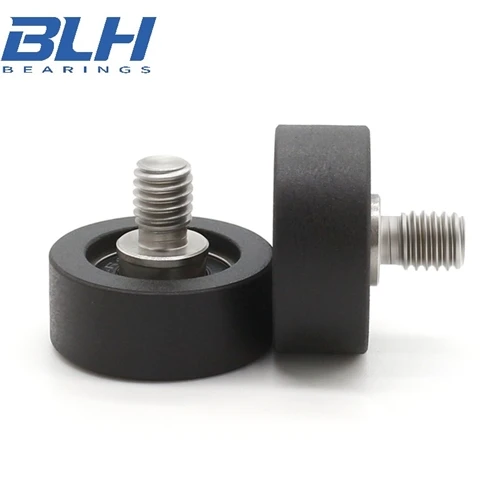
Heavy Duty Polyurethane Rollers
At BLH Bearing Factory we manufacture Non-Marking Rubber Roller Wheels, Heavy Duty Polyurethane Rollers, and Guide Pulley Bearing Wheels for industrial equipment that cannot afford floor marks, premature wear, or unreliable guidance. These rollers are built for continuous use in warehouses, packaging lines, conveyor systems, and material-handling carts where clean floors and consistent performance matter.
The outer layer is a carefully formulated polyurethane or non-marking rubber compound bonded to a precision bearing core. This combination delivers quiet running, strong load capacity, and resistance to abrasion and many common industrial fluids. Non-marking versions leave no black streaks on epoxy or polished floors, while the heavy-duty polyurethane grades handle higher loads and longer duty cycles without flat-spotting. Guide pulley bearing wheels add accurate tracking for belts and chains, reducing side load and extending the life of the driven components.
We control the entire process in-house-from bearing selection and core preparation to polyurethane mixing, coating thickness, and curing. Hardness, outer diameter, tread profile, and bore or stud configuration can be adjusted to match specific equipment. Every batch is checked for hardness consistency, bond strength, and run-out before it leaves the factory. This attention to detail is why the same rollers are specified repeatedly by overseas buyers who need reliable drop-in replacements or custom solutions.
Typical applications include conveyor side guides, transfer carts, packaging machinery, and light-to-medium industrial vehicles. The non-marking compounds protect finished floors in clean facilities, while the heavy-duty polyurethane versions stand up to continuous impact and heavier loads. Guide pulley styles keep belts aligned and reduce maintenance stops.
Because we produce both the bearing cores and the elastomer covering ourselves, lead times stay predictable and quality stays consistent from sample to production order. That combination of control and flexibility has proven valuable for B2B customers who cannot risk downtime or floor damage.

Frequently Asked Questions
What does "non-marking" mean for rubber roller wheels?
Non-marking compounds are formulated so they do not leave black or colored streaks on epoxy, concrete, or polished floors under normal operating conditions. They are preferred in warehouses, food facilities, and clean production areas.
What load capacities are available for Heavy Duty Polyurethane Rollers?
Capacities vary by diameter, width, and hardness. Standard ranges cover light-to-medium industrial loads. We supply load charts and can recommend the correct size once we know the weight and duty cycle.
Can Guide Pulley Bearing Wheels be used for both belt and chain tracking?
Yes. The bearing core and outer profile are designed to guide flat belts, timing belts, and some chain applications while minimizing side load and friction.
What hardness options do you offer?
Typical hardness ranges from approximately 80A to 95A Shore. Softer compounds favor quiet operation and floor protection; harder compounds favor higher load capacity and longer wear life.
Are these rollers suitable for environments with oils or frequent cleaning?
The polyurethane grades we use resist many oils, greases, and common industrial cleaners. For aggressive chemicals we recommend confirming compatibility with a material sample.
Do you offer stainless-steel cores or special mounting options?
Stainless cores are available for wet or mildly corrosive environments. Threaded studs, plain bores, and custom shaft fits can be supplied to match existing equipment.
What information is needed to quote a custom roller?
Outer diameter, width, bore or stud size, preferred hardness, expected load, operating speed, and any environmental conditions. A photo or drawing of the current part speeds up the process.
How should these rollers be stored before installation?
Store in a cool, dry place away from direct sunlight and ozone sources. Avoid placing heavy loads on the tread for extended periods so the elastomer keeps its original shape.