

Adhesive wear of rolling deep groove ball bearings is a lubricant related damage that occurs on two surfaces due to relative sliding (see figure below).
The principle of adhesive wear
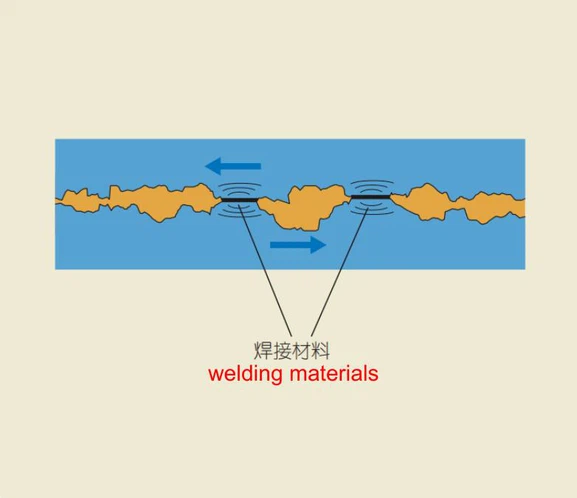
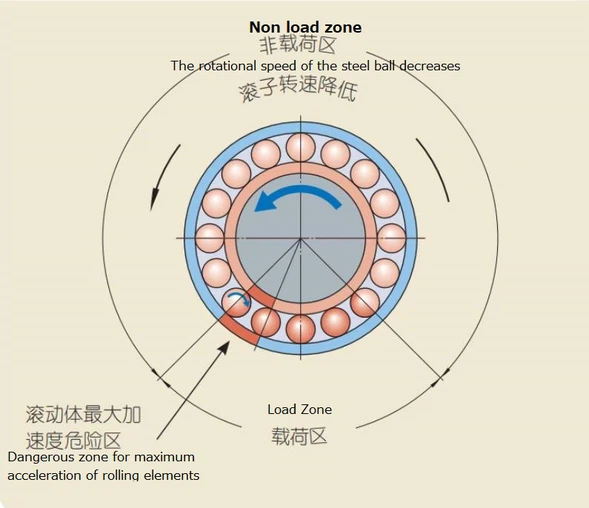
The characteristic of adhesive wear is the transfer of material from one surface to another (tailing), usually accompanied by frictional heat (sometimes leading to tempering or re hardening of the interacting surfaces). Friction generates heat and causes local stress concentration, which may lead to cracks or peeling in the contact area. Under normal operating conditions, tailing usually does not occur. The relative sliding speed between the mating surfaces is much greater than the micro sliding caused by the elastic deformation of the bearing geometry and rolling contact area. Tailing (adhesive wear) caused by high acceleration may occur on the rolling element surface and raceway of a relatively high-speed rotating rolling bearing under specific conditions. Outside the load zone, the bearing ring cannot drive the rolling elements, resulting in the rolling elements being obstructed.
Therefore, when entering the load zone, the rolling body of the deep groove ball bearing will suddenly accelerate (see the figure below). This sudden acceleration will cause the rolling elements to slide, accompanied by the generation of significant heat, resulting in the two surfaces merging at the point of metal to metal contact.
The acceleration of rolling elements entering the load zone poses a high risk of adhesive wear
During this process, there may be a transfer of material from one surface to another, and significant friction may also occur (as shown in the figure below)
Tail on the outer raceway of spherical ball bearings (sticky marks at the entrance of the load zone)
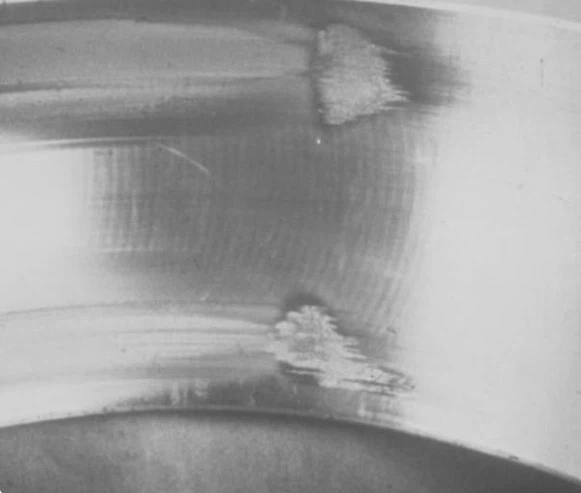
During this process, material tempering and re hardening may occur, leading to local stress concentration and the risk of cracking, ultimately resulting in premature failure of the bearing. Cracks may appear in a direction perpendicular to the sliding direction.
The trailing phenomenon is also known as the sliding or scraping phenomenon:
Tailing is a very dangerous surface damage, as the affected surface usually gradually becomes rough. As the surface roughness increases, the oil film thickness decreases, leading to metal to metal contact and a vicious cycle of bearing wear. Large bearings are particularly sensitive to trailing. The weight of rolling elements plays a very important role, and heavier rolling elements will significantly slow down in the non load zone. However, when the rolling element enters the load zone again, it almost immediately accelerates, but due to its large weight, local sliding occurs.
Tail phenomenon caused by gyroscopic effect may also occur in ball bearings. In this case, when the balls leave the load zone, their contact angle changes, but when the balls enter the load zone again, they are forced back to their original contact angle (accompanied by sliding).
Tail caused by light load (adhesive wear):
When the load is too small at the corresponding speed, tailing may also occur between the rolling elements and the raceway
The methods to solve the tailing problem include but are not limited to the following:
1. Increase the load on the bearing
2. Use smaller bearings
3. Use hybrid ceramic bearings (with lighter rolling elements)
4. Apply protective coatings
5. Use different holders
6. Check if the selected lubricating oil/grease is appropriate
Other examples of trailing (adhesive damage):
Tail will also occur between the retainer and its contact surface, as well as between the roller end face and the guide flange. As shown in the figure below, the tail between one roller of the spherical roller thrust bearing and the guide flange. The end face of the rolling element is damaged due to insufficient lubrication, resulting in trailing damage.

Thank you for following my article. Our factory can OEM/ODM various types of bearings. Our product features include high temperature resistance, corrosion resistance, high speed, and low noise. If you have any bearing transmission problems, please feel free to contact me. I will give you a one-on-one answer:
Email: jackengineer@blhbearing.com
WhatsApp:8613760352799


