


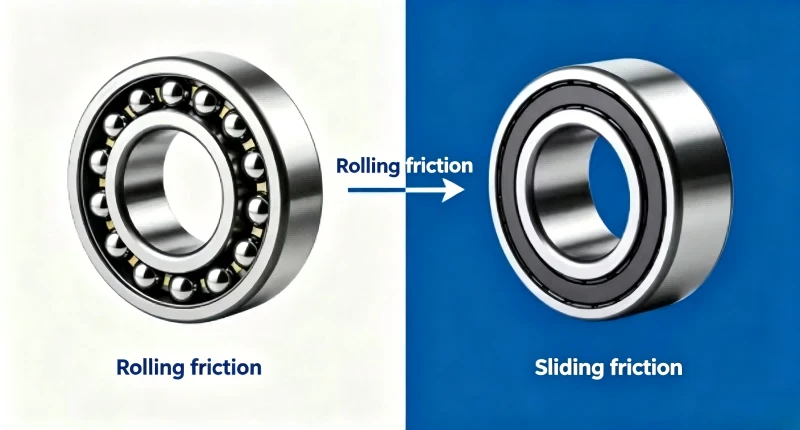
Many mechanics, procurement, and process personnel have been in the industry for many years, but still cannot distinguish the true difference between rolling bearings and sliding bearings. Most people only know that 'one has ball bearings and the other doesn't', but they don't know that choosing the wrong working condition can directly lead to equipment short life, frequent locking, excessive vibration, and doubled maintenance costs. This article uses a simple and practical approach to comprehensively compare two types of bearings, helping everyone thoroughly understand the selection logic.
Structural difference:
Rolling bearings are modular standard components with a complete structure, including inner and outer rings, rolling elements, retainers, seals, and internal steel balls or rollers that can roll. It relies on rolling friction to work, with minimal frictional resistance.
Sliding bearings are mostly composed of shaft sleeves and bearing shells, without rolling elements or retainers. They have a smooth sleeve structure and rely on sliding friction and oil film support to bear the load. The structural differences directly determine all the differences in speed, load capacity, shock absorption, and maintenance.
Speed and heat generation: Rolling bearings are the preferred choice for high-speed equipment
Rolling bearings have an extremely low coefficient of friction, low starting resistance, light and agile operation, low temperature rise during high-speed rotation, and good stability. They are very suitable for equipment such as motors, fans, water pumps, and centrifuges that operate at high speeds for a long time.
Sliding bearings have high frictional resistance and are prone to overheating, tile sticking, and shaft gripping during high-speed operation, making them only suitable for medium and low-speed working conditions. If high-speed equipment forcibly uses sliding bearings and the cooling and lubrication are not in place, it will fail at high temperatures in a short period of time.
Load bearing and impact resistance: Identify sliding bearings under heavy load conditions
Rolling bearings are in point and line contact, with concentrated load-bearing capacity, and are afraid of impact and overload. Once the equipment experiences instantaneous impact loads, rolling elements are prone to indentation, peeling, and abnormal noise.
Sliding bearings have surface contact, uniform force distribution, sufficient rigidity, and strong impact resistance. They have obvious advantages in heavy-duty impact scenarios such as crushers, rolling mills, heavy-duty machine tools, and mining equipment.
Load bearing and impact resistance: Identify sliding bearings under heavy load conditions
Rolling bearings are in point and line contact, with concentrated load-bearing capacity, and are afraid of impact and overload. Once the equipment experiences instantaneous impact loads, rolling elements are prone to indentation, peeling, and abnormal noise.
Sliding bearings have surface contact, uniform force distribution, sufficient rigidity, and strong impact resistance. They have obvious advantages in heavy-duty impact scenarios such as crushers, rolling mills, heavy-duty machine tools, and mining equipment.
Accuracy, noise, and shock absorption: Silent devices prioritize sliding
Rolling bearings have assembly clearance, and there may be slight periodic vibrations and noise during high-speed operation.
Sliding bearings rely on oil film buffering, which ensures smoother operation, lower noise, and better shock absorption effect. They are suitable for precision equipment, quiet workshops, high-end machine tools, and other scenarios that are sensitive to vibration noise.
Maintenance cost and universality
Rolling bearings have a high degree of standardization according to national standards, are easy to disassemble and assemble, quick to replace, easy to stock, and have a long lubrication cycle, making them suitable for the vast majority of general-purpose equipment. Sliding bearings have extremely high requirements for installation accuracy, coaxiality, and oil supply system. They are complex to install, tedious to maintain, and mostly non-standard, making them suitable for specialized heavy-duty equipment.
Summary
High speed light load, universal equipment, pursuit of good maintenance and selection of rolling bearings; Low speed heavy load, impact working conditions, silent precision, choose sliding bearings for heavy equipment. Choose the right type, and the equipment failure rate will be halved directly.


