Ball bearings are primarily categorized into three types: deep groove ball bearings, angular contact ball bearings, and thrust ball bearings. Each has unique structural features and application scenarios, meeting the needs of various operating conditions.
As an indispensable and key component in mechanical equipment, ball bearings come in a wide variety of types with diverse functions. Among these types, deep groove ball bearings, angular contact ball bearings, and thrust ball bearings have become the three pillars of the ball bearing industry due to their wide range of applications and unique performance advantages.
1. Deep Groove Ball Bearings
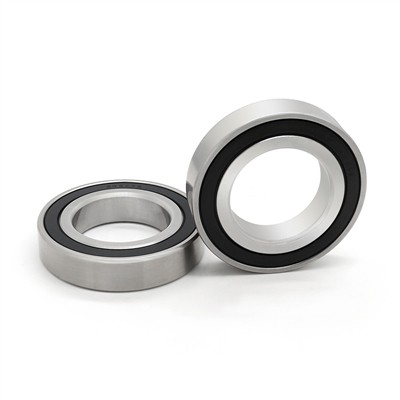
Deep groove ball bearings, also known as single-row radial ball bearings, are the most basic and common type of ball bearing. Their structural characteristic is the deep grooves in both the inner and outer ring raceways, allowing them to withstand both radial and bidirectional axial loads, though radial loads are the primary support. This design enables deep groove ball bearings to have a high maximum speed and a low coefficient of friction. They are widely used in automobiles, machine tools, motors, and other fields, serving as a crucial component for supporting rotating bodies and reducing friction and wear.
2. Angular Contact Ball Bearings
Angular contact ball bearings stand out for their unique angular contact design. The contact angle between the inner and outer ring raceways allows them to withstand large axial loads. As the contact angle increases, their axial load capacity increases accordingly. Angular contact ball bearings are particularly suitable for applications requiring high precision, high speed, and axial displacement, such as machine tool spindles and precision instruments. Furthermore, various angular contact ball bearing combinations can be created to meet more complex operating requirements.
Third. Thrust Ball Bearings
Thrust ball bearings specialize in carrying axial loads. Their structural characteristics are that the inner ring fits the shaft, while the outer ring fits within the housing bore, allowing them to independently withstand axial loads in one direction. Thrust ball bearings are suitable for applications with purely or predominantly axial loads, such as crane hooks and vertical water pumps. Their simple design, ease of manufacture, and good interchangeability make them ideal for axial positioning and support.