Deep Groove Ball Bearings
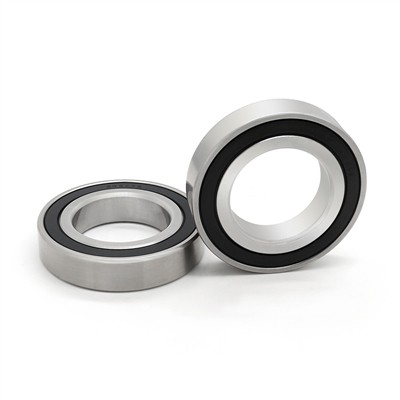
Deep groove ball bearings are the most widely used type of ball bearing, primarily designed to carry radial loads. Their simple structure makes them suitable for high-speed operating environments. Due to their low coefficient of friction, deep groove ball bearings are particularly well-suited for applications requiring combined loads. Their simple structure also facilitates high-precision production, making them suitable for large-scale applications.
Angular Contact Ball Bearings
Angular contact ball bearings are characterized by their excellent axial load capacity and are suitable for use in high-speed, high-precision, and low-vibration environments. These bearings are typically mounted in pairs to balance internal axial forces. The contact angle is a key consideration when selecting a bearing, as its size directly affects the axial force it can withstand.
Self-Aligning Ball Bearings
Self-Aligning Ball Bearings offer self-aligning properties and are particularly suitable for applications involving shaft deflection or where the bearing seat bore positioning accuracy is poor in long shafts. Due to their relatively low rigidity, they are best suited for low-speed applications where noise and vibration are not particularly critical.
Thrust Ball Bearings
Thrust ball bearings are designed to carry high axial loads and are particularly well-suited for low-speed, high-torque applications. This bearing type is specifically designed to handle high axial loads, making it a very useful type.
Special Constructions
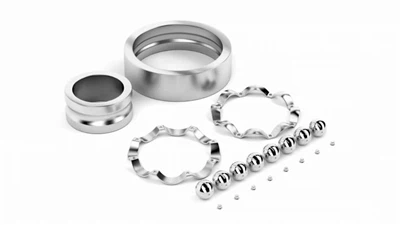
In addition to conventional designs, several ball bearings with specialized constructions are available. The filler groove design allows for more balls to be packed into the inner ring, providing additional radial load capacity. The snap ring design simplifies housing construction and helps reduce bearing size, while the locking design facilitates direct mounting on straight shafts.