Foreword
Plain bearings are commonly used components in centrifugal pump structures to achieve sliding of moving parts within stationary parts. According to the direction of force, it can be divided into radial sliding bearings that bear radial force (lateral force) and axial sliding bearings (thrust bearings) that bear axial force (longitudinal force).
Radial sliding bearing
In radial sliding bearings, the rotating component is the journal; The stationary component is the bearing shell. Sliding bearings of different structural types:
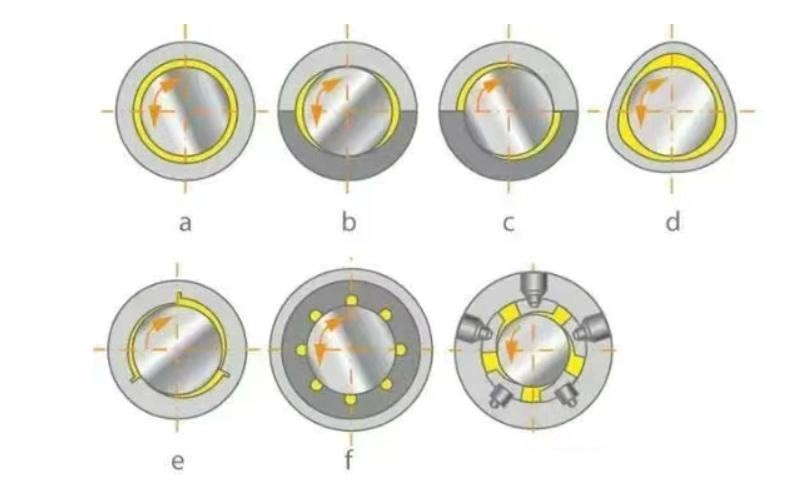
a. Single oil blade cylindrical sliding bearing;
b. Double oil blade elliptical sliding bearing;
c. Two oil leaf misaligned sliding bearings;
d. Three oil leaf sliding bearings;
e. Three blade and multi blade sliding bearings with lubrication grooves or oil chambers;
f. Rubber sliding bearings;
g. Radial tilting pad sliding shaft
The need for such diverse bearing designs is to adapt to the unique dynamic operating characteristics of centrifugal pump rotors. The vibration characteristics of rotors equipped with sliding bearings mainly depend on the rotor mass, mass distribution, shaft stiffness, and damping characteristics of the bearings under specific loads.
By rational structural design of rotor bearings, two types of lateral rotor vibrations (forced vibration and self-excited vibration) that have a significant impact on equipment can be eliminated or controlled within an acceptable range, thereby optimizing the dynamic characteristic parameters of sliding bearings. The selection of bearing structural types constitutes an important component of the optimization design of bearing structural parameters, as the performance characteristics of bearings with different structural types also vary.
The bearing clearance is achieved through precise dimensional design and mutual coordination between moving and stationary bearing components. The gap is filled with liquid or solid (grease type) lubricant to avoid sliding friction. When the journal reaches sufficient circumferential velocity, the bearing clearance will cause the lubricant to form a load-bearing wedge. The lubricating wedge separates the sliding surface, indicating that the bearing is operating in a fully liquid lubricated state. This process is a typical feature of fluid dynamic sliding bearings.
Advantages of fluid dynamic sliding bearings
1) The manufacturing process is simple, and the lubricant is input into the bearing at no pressure or extremely low oil supply pressure during operation;
2) The energy consumption required for the lubricating oil system is extremely low or almost zero.
Advantages of Hydrostatic Sliding Bearings
1) Full liquid film lubrication can be achieved throughout the entire process (including start-up and shutdown phases), with no risk of excessive wear;
2) Under the same load-bearing capacity, it has a more compact structure and lower friction loss compared to fluid dynamic pressure bearings.
Friction state in sliding bearings
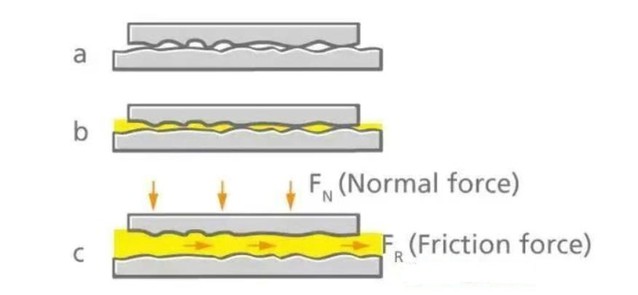
a. Dry friction: Friction between stationary and moving parts without a lubricating isolation layer, where the two surfaces come into direct contact
b. Mixed friction: a combination of dry friction and fluid friction
c. Fluid Friction: A lubricant isolation layer is filled between two sliding friction surfaces (ideal working condition)
During the operation of fluid dynamic sliding bearings, three types of friction states may occur in three stages: start-up, normal operation, and shutdown. The start-up phase refers to the process of reaching the rated operating speed from a stationary state. As the sliding speed increases, the bearing will experience a mixed friction state, where the dry friction component is gradually replaced by fluid friction as the speed further increases. When the transition point is reached, the friction surface is completely separated, establishing a fully liquid film lubrication state, at which point the friction loss is minimized.
When the machine stops, the sliding bearings will undergo the same but in reverse order state changes as the above start-up process. The steady-state operating point of sliding bearings should usually be in the stage of full liquid film lubrication. If mixed friction occurs during continuous operation, it will cause excessive wear on the bearing working surface. Special attention should be paid to correctly selecting the two surface materials that require lubrication (considering wear and heat dissipation performance).
Many pump devices use guide bearings lubricated by the pumped fluid itself. In this case, the selection of bearing materials is particularly crucial, as different fluids have their own characteristics as lubricants.
If water is used as a lubricant, various bearing materials with suitable tribological properties can be selected, including metal alloys, elastic materials, hard rubber, graphite with or without resin binder, hard graphite with or without resin binder or antimony impregnation, etc.
If the pumping medium containing impurities or solid particles (such as sand particles) is used as a lubricant, the bearing material should be made of hard metal or ceramic material (such as silicon carbide). Using the same material to manufacture bearings (bushings) and bushings constitutes a maintenance free sliding bearing.
Fiber reinforced ceramic bearings are becoming increasingly widely used due to their excellent tensile strength and fracture resistance.
Friction energy is converted into heat, which is partially dissipated into the surrounding air through the bearing seat or shaft. Therefore, the working temperature of sliding bearings should not exceed the maximum allowable operating temperature. If necessary, a cooling system (usually using water cooling) should be installed for the bearings or lubricants.
The design of fluid dynamic pressure sliding bearings requires solving a complex problem that involves a comprehensive consideration of multiple factors, including bearing geometry and size, bearing load, lubricant viscosity, sliding speed, flow properties inside the bearing, and the interaction relationship between these factors.
The design goal of sliding bearings is to ensure reliable and complete fluid dynamic lubrication during operation. The design process combines theoretical principles with experimental data, and considers multiple interrelated characteristic coefficients (such as the correlation coefficient of radial sliding bearings)
Sliding bearings with lubricants that do not exhibit pure laminar flow characteristics (i.e. bearings with extremely high rotational speeds and low lubricant viscosity) often have higher load-bearing capacity, but also generate greater friction losses. In this case, the property differences between laminar and turbulent flow play a decisive role, and in addition, the various characteristic coefficients of the aforementioned sliding bearings need to be comprehensively considered. Designing sliding bearings with turbulent lubricants is much more complex than designing bearings with laminar lubrication.
Axial (thrust) sliding bearing
The moving parts of axial (thrust) sliding bearings are thrust rings or thrust discs.
Thrust without bearings, stationary components, and their variants
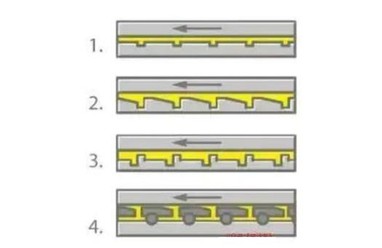
1. Thrust bearings with grooves;
2. Thrust bearings with inclined surfaces;
3. Thrust bearings with stepped flat surfaces;
4. Eccentrically supported tilting pads or commonly used center supported tilting pads [for example, used when the cooling water pump needs to rotate in the opposite direction due to pipeline backflow (turbine mode)
According to different design types, thrust sliding bearings can be divided into fluid dynamic pressure, fluid static pressure, and dynamic static pressure composite sliding bearings for special applications. Both basic design types must allow for sufficient axial displacement of the shaft to accommodate changes in the thickness of the lubricating film - which varies with load, lubricant viscosity, and sliding speed. The discussion on the advantages and disadvantages of hydrodynamic and hydrostatic thrust sliding bearings is consistent with that of radial sliding bearings.
For more bearing knowledge, please contact our engineers via email. Thank you!