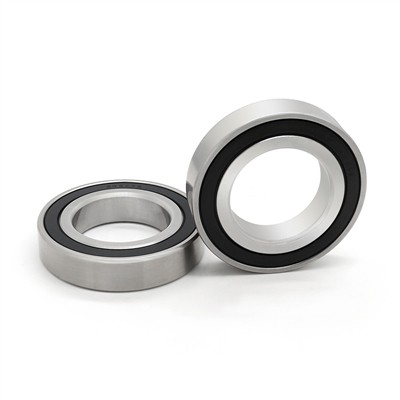
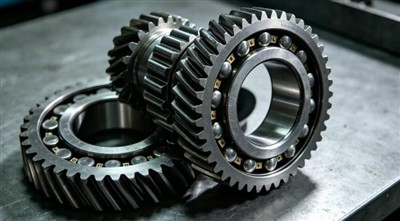
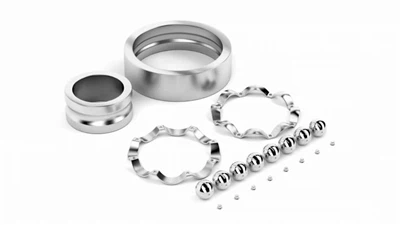
Ball bearings are primarily classified into three categories: deep groove ball bearings, angular contact ball bearings, and thrust ball bearings.
Ball bearings are a common bearing type used in mechanical equipment and are widely used in various industrial fields. Based on their structure and application, ball bearings are classified into the following categories:
1. Deep Groove Ball Bearings
Deep groove ball bearings are a representative rolling bearing with a wide range of applications. They primarily support radial loads, but can also withstand certain axial loads. When the radial clearance of the bearing is increased, they exhibit the performance of angular contact ball bearings and can withstand larger axial loads. Furthermore, these bearings have a certain degree of self-alignment and can still operate normally when tilted 2' to 10' relative to the housing bore, although this has a certain impact on bearing life. Deep groove ball bearing cages are mostly stamped steel with a corrugated shape, while larger bearings often use machined metal solid cages.
2. Angular Contact Ball Bearings
Angular contact ball bearings can support both radial and axial loads, or purely axial loads. They have a high maximum speed and can support both radial and axial loads, as well as pure axial loads. Their axial load capacity is determined by the contact angle and increases with increasing contact angle. Single-row angular contact ball bearings can only support axial loads in one direction. When supporting radial loads, additional axial forces are generated, requiring the corresponding reverse load to be applied. Therefore, these bearings are generally used in pairs. Double-row angular contact ball bearings can withstand large combined radial and axial loads and moment loads, primarily radial loads. They can limit bidirectional axial displacement of the shaft or housing and have a contact angle of 30 degrees.
Third. Thrust Ball Bearings
Thrust ball bearings are separable bearings. The shaft washer and seat washer can be separated from the cage and steel ball assembly, making them easy to install and disassemble. Thrust ball bearings consist of a washer, balls, and cage. The thrust element that mates with the shaft is called the shaft washer, while the seat washer mates with the housing. Thrust ball bearings can only support axial loads. Single-direction thrust ball bearings can only support axial loads in one direction, while double-direction thrust ball bearings can support axial loads in both directions. They cannot bear radial loads. Thrust ball bearings also have a structure with a seat pad. Since the mounting surface of the seat pad is spherical, the bearing has a self-aligning performance, which can reduce the impact of installation errors.