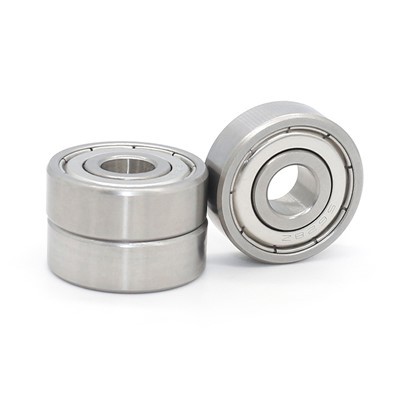
As a supplier of 6900 bearings, I often encounter inquiries about the surface finish of these bearings. Surface finish is a critical factor that can significantly impact the performance, durability, and overall quality of a bearing. In this blog post, I will delve into what the surface finish of a 6900 bearing entails, its importance, and how it relates to the bearing's functionality.
Understanding Surface Finish
Surface finish refers to the texture of a surface, which is determined by the machining or manufacturing process used to create it. In the context of 6900 bearings, the surface finish encompasses the smoothness, roughness, and irregularities present on the bearing's raceways, rolling elements, and other contact surfaces. These characteristics are typically measured in terms of roughness average (Ra), which represents the arithmetic average of the absolute values of the surface height deviations from the mean line within a specified sampling length.
The surface finish of a 6900 bearing is crucial because it directly affects the bearing's ability to operate smoothly and efficiently. A smooth surface finish reduces friction, wear, and heat generation, which in turn extends the bearing's service life and improves its overall performance. On the other hand, a rough or uneven surface finish can lead to increased friction, premature wear, and even bearing failure.
Importance of Surface Finish in 6900 Bearings
Reduced Friction
One of the primary benefits of a smooth surface finish is reduced friction. When the bearing's raceways and rolling elements have a smooth surface, they can roll and slide against each other with minimal resistance. This reduces the amount of energy required to operate the bearing, resulting in lower power consumption and improved efficiency. Additionally, reduced friction also helps to prevent overheating, which can cause damage to the bearing and other components in the system.
Improved Wear Resistance
A smooth surface finish also enhances the bearing's wear resistance. When the surface is free of roughness and irregularities, the rolling elements can distribute the load evenly across the raceways, reducing the stress concentration on specific areas. This helps to prevent premature wear and extends the bearing's service life. In contrast, a rough surface finish can cause the rolling elements to wear unevenly, leading to increased wear and potential failure.
Enhanced Lubrication
Surface finish plays a crucial role in the lubrication of 6900 bearings. A smooth surface provides a better foundation for the lubricant to form a thin film between the rolling elements and the raceways. This lubricating film helps to reduce friction, prevent metal-to-metal contact, and protect the bearing from wear and corrosion. On the other hand, a rough surface can disrupt the lubricant film, leading to increased friction and wear.
Noise and Vibration Reduction
A smooth surface finish can also contribute to the reduction of noise and vibration in the bearing. When the bearing operates smoothly, there is less noise and vibration generated, which can improve the overall comfort and performance of the equipment. In contrast, a rough surface finish can cause the bearing to produce more noise and vibration, which can be a sign of potential problems and may require further investigation.
Surface Finish Requirements for 6900 Bearings
The surface finish requirements for 6900 bearings can vary depending on the specific application and operating conditions. In general, the raceways and rolling elements of a 6900 bearing should have a smooth surface finish with a low Ra value. For most applications, a Ra value of 0.02 to 0.05 micrometers is considered acceptable. However, for high-precision applications, such as those in the aerospace or medical industries, a lower Ra value may be required.
In addition to the Ra value, other surface finish parameters, such as the waviness and lay of the surface, may also be important. Waviness refers to the long-wavelength irregularities on the surface, while lay refers to the direction of the surface texture. These parameters can affect the bearing's performance and should be carefully controlled during the manufacturing process.
Manufacturing Processes for Achieving the Desired Surface Finish
To achieve the desired surface finish for 6900 bearings, various manufacturing processes are used. These processes include grinding, honing, lapping, and polishing.
Grinding
Grinding is a common manufacturing process used to achieve a smooth surface finish on the bearing's raceways and rolling elements. In this process, a grinding wheel is used to remove material from the surface of the bearing, creating a smooth and precise finish. Grinding can be performed using different types of grinding wheels, depending on the material and the desired surface finish.
Honing
Honing is a finishing process that is used to improve the surface finish and dimensional accuracy of the bearing's raceways. In this process, a honing tool is used to remove a small amount of material from the surface of the raceway, creating a smooth and uniform finish. Honing can be used to achieve a very low Ra value and is often used for high-precision applications.
Lapping
Lapping is a precision finishing process that is used to achieve an extremely smooth surface finish on the bearing's rolling elements. In this process, a lapping plate is used to rub the rolling elements against a lapping compound, which removes a small amount of material from the surface of the rolling elements, creating a mirror-like finish. Lapping can be used to achieve a very low Ra value and is often used for high-precision applications.
Polishing
Polishing is a finishing process that is used to improve the surface finish and appearance of the bearing. In this process, a polishing wheel or abrasive is used to remove a small amount of material from the surface of the bearing, creating a smooth and shiny finish. Polishing can be used to achieve a very low Ra value and is often used for aesthetic purposes.


Related Products and Applications
As a 6900 bearing supplier, we also offer a wide range of other bearings for various applications. Some of our related products include:
- Gyroscope Bearing S608RS: These bearings are designed for use in gyroscopes and other precision instruments, where high accuracy and reliability are required.
- High-Precision High-Speed Intelligent Dental Bearing S624ZZ: These bearings are specifically designed for use in dental equipment, where high speed and precision are essential.
- 6300 Series Deep Groove Ball Bearings: These bearings are widely used in various industrial applications, such as motors, pumps, and conveyors.
- Washing Machinery Application Bearings S698RS: These bearings are designed for use in washing machines and other household appliances, where high durability and reliability are required.
- Aircraft Bearings 693ZZ: These bearings are specifically designed for use in aircraft applications, where high performance and safety are of utmost importance.
Conclusion
In conclusion, the surface finish of a 6900 bearing is a critical factor that can significantly impact its performance, durability, and overall quality. A smooth surface finish reduces friction, wear, and heat generation, which in turn extends the bearing's service life and improves its efficiency. To achieve the desired surface finish, various manufacturing processes, such as grinding, honing, lapping, and polishing, are used. As a 6900 bearing supplier, we are committed to providing high-quality bearings with the best surface finish to meet the needs of our customers.
If you are interested in purchasing 6900 bearings or any of our other products, please feel free to contact us for more information and to discuss your specific requirements. We look forward to working with you.
References
- "Bearing Design and Application Handbook" by SKF
- "Mechanical Engineering Design" by Joseph E. Shigley and Charles R. Mischke
- "Manufacturing Engineering and Technology" by Serope Kalpakjian and Steven R. Schmid