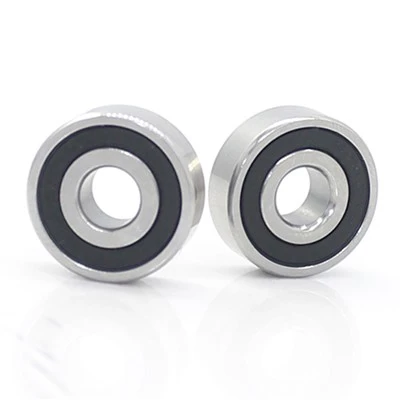
As a supplier of 6900 bearings, I often encounter inquiries about the clearance of these bearings. Understanding bearing clearance is crucial for ensuring optimal performance and longevity in various applications. In this blog post, I'll delve into what the clearance of a 6900 bearing is, why it matters, and how it impacts the operation of machinery.
What is Bearing Clearance?
Bearing clearance refers to the amount of internal play or space between the bearing's rolling elements (balls or rollers) and the raceways. It is typically measured in micrometers (μm) or thousandths of an inch (mils). There are two main types of bearing clearance: radial clearance and axial clearance.
- Radial Clearance: This is the clearance measured in the radial direction, perpendicular to the bearing's axis. It affects the bearing's ability to accommodate radial loads and its rotational accuracy.
- Axial Clearance: Axial clearance is measured parallel to the bearing's axis. It plays a role in the bearing's ability to handle axial loads and its axial positioning.
Clearance of 6900 Bearing
The 6900 bearing is a deep groove ball bearing, which is one of the most commonly used types of bearings. The standard clearance for a 6900 bearing is typically specified by the bearing manufacturer. For example, in the ISO 5753 standard, there are several clearance classes, including C0 (normal clearance), C1 (less clearance than normal), C2 (slightly less clearance than normal), C3 (greater clearance than normal), C4 (even greater clearance), and C5 (the largest clearance).
The choice of clearance class depends on various factors, such as the application's operating conditions, load type, and temperature. For instance, in applications where the bearing is subjected to high radial loads and low operating temperatures, a smaller clearance class like C1 or C2 may be preferred. On the other hand, in applications with high temperatures or where the bearing needs to accommodate thermal expansion, a larger clearance class like C3, C4, or C5 may be more suitable.
Importance of Proper Clearance
Proper bearing clearance is essential for several reasons:
- Load Distribution: The right clearance ensures that the load is evenly distributed among the rolling elements. If the clearance is too small, the bearing may experience excessive stress, leading to premature wear and failure. Conversely, if the clearance is too large, the bearing may not be able to support the load effectively, resulting in increased vibration and noise.
- Temperature Management: Clearance also affects the bearing's temperature. A bearing with the correct clearance will generate less heat during operation, which helps to extend its service life. In high-temperature applications, a larger clearance can prevent the bearing from seizing due to thermal expansion.
- Rotational Accuracy: For applications that require high rotational accuracy, such as machine tools and precision instruments, a smaller clearance is necessary to minimize radial and axial runout.
Applications of 6900 Bearing and Clearance Considerations
The 6900 bearing is widely used in various industries, including automotive, industrial machinery, and household appliances. Here are some examples of applications and the corresponding clearance considerations:
- Automotive Applications: In automotive engines, 6900 bearings are used in components such as alternators and water pumps. These applications typically require a smaller clearance to ensure precise operation and reduce noise. A C1 or C2 clearance class may be suitable for these applications.
- Industrial Machinery: In industrial machinery, such as conveyor systems and electric motors, the 6900 bearing may be subjected to a wide range of operating conditions. Depending on the load and temperature, a clearance class from C0 to C3 may be appropriate. For example, in a conveyor system operating at a moderate temperature and carrying a relatively light load, a C0 clearance may be sufficient. However, in an electric motor operating at high speeds and generating significant heat, a C3 clearance may be needed to accommodate thermal expansion.
- Household Appliances: In household appliances like washing machines and refrigerators, the 6900 bearing is used to support rotating components. These applications often require a balance between cost and performance. A C0 or C2 clearance class is commonly used in these applications to provide reliable operation while keeping costs down.
Other Related Bearings
In addition to the 6900 bearing, we also offer a variety of other bearings that may be suitable for different applications. Here are some examples:


- S606-2RS Stainless Steel Bearing: A High-Speed, Quiet Bearing For Miniature Motors: This bearing is made of stainless steel, which makes it resistant to corrosion. It is designed for high-speed and quiet operation, making it ideal for miniature motors.
- Freewheel Bearing 623UG: The 623UG freewheel bearing allows the shaft to rotate in one direction while preventing rotation in the opposite direction. It is commonly used in applications such as bicycles and power tools.
- High-Precision High-Speed Intelligent Dental Bearing S624ZZ: This bearing is designed for high-precision and high-speed operation in dental equipment. It features advanced technology to ensure reliable performance and long service life.
- Washing Machinery Application Bearings S698RS: These bearings are specifically designed for use in washing machines. They are able to withstand the high loads and vibrations associated with washing machine operation.
- 61900ZZ-HLC Deep Groove Ball Bearing: The 61900ZZ-HLC bearing is a deep groove ball bearing with a shield on both sides. It offers high load capacity and low friction, making it suitable for a wide range of applications.
Conclusion
In conclusion, the clearance of a 6900 bearing is a critical factor that affects its performance and longevity. By understanding the different clearance classes and their applications, you can choose the right bearing for your specific needs. Whether you're in the automotive, industrial, or household appliance industry, we can provide you with high-quality 6900 bearings and other related products.
If you're interested in purchasing 6900 bearings or any of our other products, please don't hesitate to contact us for a detailed discussion. Our team of experts is ready to assist you in finding the best solutions for your applications.
References
- ISO 5753: Rolling bearings - Radial internal clearance
- Bearing Design and Application Handbook