


Hey there, folks! I'm a supplier of screw bearings, and I'm super stoked to dive into what these little wonders can do. Screw bearings might not be the most well - known parts out there, but they play a crucial role in all sorts of applications.
Let's start with the basics. A screw bearing is a type of bearing that has a threaded outer ring or a screw - like feature. This design gives it some unique functions that set it apart from regular bearings.
1. Mounting and Positioning
One of the primary functions of a screw bearing is for mounting and positioning. The threaded part allows the bearing to be easily screwed into a housing or a specific location. This is a huge advantage in applications where precise positioning is required. For example, in some machinery, you need to place a bearing at a very specific spot. With a screw bearing, you can simply turn it into place, and it'll stay right where you want it.
Think about a small robotic arm. You need to attach the joints in the right position so that the arm can move accurately. A screw bearing can be screwed directly into the joint housing, ensuring that the bearing is firmly in place and that the joint can function smoothly. This is much more convenient than using other mounting methods like press - fitting, which might require special tools and can be more difficult to adjust if needed.
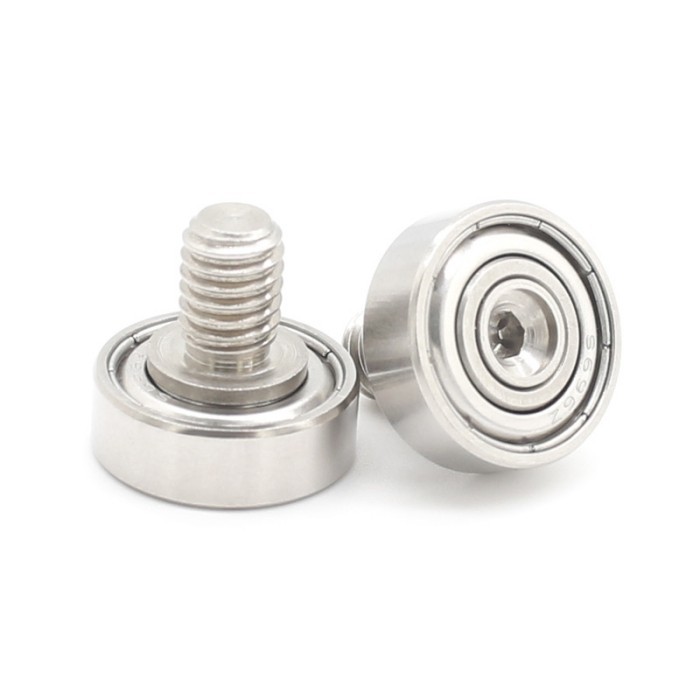
We offer a great product called External Threaded Bearing 6002ZZ With Screw. This bearing is perfect for applications where you need easy mounting and precise positioning. Its threaded design makes it a breeze to install, and it provides reliable performance once in place.
2. Adjustability
Another cool function of screw bearings is adjustability. Since they can be screwed in or out, you can fine - tune their position. This is especially useful in applications where the load or the operating conditions might change over time.
For instance, in a conveyor system, the tension of the belt might need to be adjusted. By using screw bearings, you can easily move the bearing to change the position of the pulley, which in turn adjusts the belt tension. This adjustability helps to optimize the performance of the system and can extend the lifespan of the components.
Our Screw BearingsS696ZZ is a great option for applications that require adjustability. You can easily turn the bearing to make small adjustments, and it'll hold its position firmly once you're satisfied with the setting.
3. Vibration Damping
Screw bearings can also help with vibration damping. The threaded connection between the bearing and the housing can act as a buffer, reducing the amount of vibration that is transmitted through the system. This is important in applications where excessive vibration can cause damage to the components or affect the quality of the product.
Take a high - speed motor, for example. Vibration can lead to premature wear of the bearings and other parts, and it can also cause noise. By using screw bearings, the vibration can be absorbed to some extent, resulting in a smoother operation and a longer lifespan for the motor.
Our Screw BearingsS609ZZ is designed to provide good vibration damping properties. It can help to keep your equipment running quietly and smoothly, even under high - speed or high - load conditions.

4. Load Distribution
Screw bearings are also effective at distributing loads. The threaded design allows the bearing to make contact with the housing over a larger area, which helps to spread the load more evenly. This is beneficial in applications where heavy loads are involved.
In a large - scale industrial machine, the components need to withstand a lot of stress. A screw bearing can help to distribute the load across the housing, reducing the risk of local stress concentrations that could lead to failure. This means that the machine can operate more reliably and safely.
5. Self - Locking
The self - locking feature of screw bearings is another important function. Once the bearing is screwed into place, it tends to stay there without the need for additional locking mechanisms. This is a great advantage in applications where the bearing needs to maintain its position over a long period of time.
For example, in a stationary piece of equipment, you don't want the bearing to loosen due to vibrations or other external factors. A screw bearing's self - locking ability ensures that it remains in place, providing consistent performance.
Applications of Screw Bearings
Screw bearings are used in a wide range of industries. In the automotive industry, they can be found in various components such as steering systems and suspension systems. Their adjustability and load - distribution functions make them ideal for these applications.
In the aerospace industry, where precision and reliability are of utmost importance, screw bearings are used in control mechanisms and other critical parts. Their ability to be accurately positioned and their vibration - damping properties are highly valued.
In the medical field, screw bearings are used in equipment such as surgical robots and diagnostic machines. The precise positioning and adjustability are crucial for the accurate operation of these devices.
Why Choose Our Screw Bearings?
As a supplier, we take pride in offering high - quality screw bearings. Our products are made from top - notch materials, which ensures their durability and performance. We have a team of experts who are constantly working on improving our designs and manufacturing processes.
We also offer a wide range of sizes and specifications to meet the diverse needs of our customers. Whether you need a small bearing for a delicate application or a large one for heavy - duty use, we've got you covered.
If you're in the market for screw bearings, I encourage you to get in touch with us. We'd be more than happy to discuss your specific requirements and help you find the right bearing for your application. We can provide you with detailed product information, technical support, and competitive pricing. So, don't hesitate to reach out and start a conversation with us.
References
- "Bearing Handbook" by SKF
- "Mechanical Design in Three Dimensions" by David Crolla


