


Hey there! As a supplier of screw bearings, I often get asked if these little wonders can handle heavy - duty applications. Well, let's dive right in and explore this question together.
First off, what are screw bearings? Screw bearings are a type of non - standard bearing that have a threaded outer ring. This threaded design allows for easy installation and adjustment in various machinery. They come in different sizes and models, like the External Threaded Bearing 6002ZZ With Screw, Screw BearingsS696ZZ, and Screw BearingsS609ZZ.
Now, when we talk about heavy - duty applications, we're looking at scenarios where the bearings have to deal with high loads, high speeds, and often harsh operating conditions. Think about industrial machinery in manufacturing plants, construction equipment, or even some automotive applications.
Let's start with the load - handling capacity. Screw bearings are designed to support radial loads, and in some cases, they can also handle a certain amount of axial load. The load - carrying capacity depends on several factors, such as the size of the bearing, the material it's made of, and the quality of the manufacturing process.
For smaller screw bearings, like the S696ZZ, they might not be the best choice for extremely heavy - duty applications. These bearings are more suitable for light - to medium - load applications, such as in some small - scale automation equipment or precision instruments. They can handle a few hundred kilograms of load, but when you're talking about tons of load, they'll quickly reach their limit.
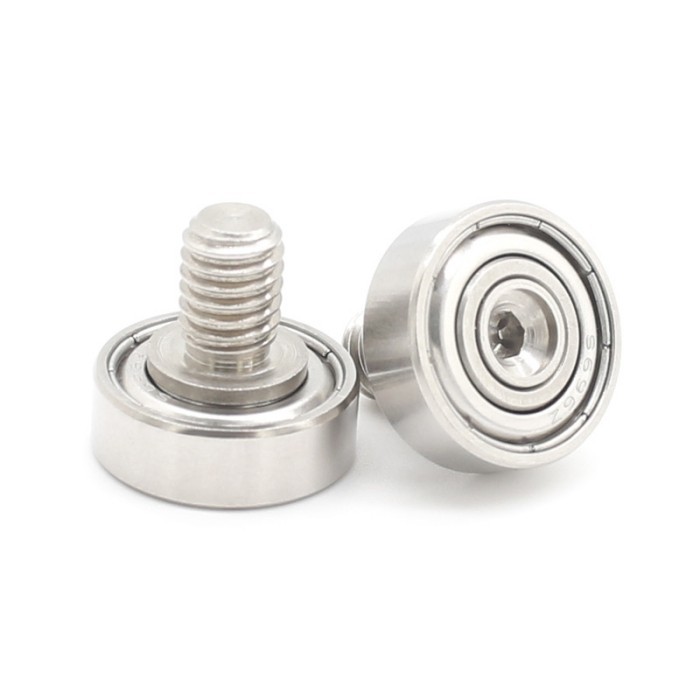

On the other hand, larger screw bearings, like the External Threaded Bearing 6002ZZ With Screw, have a much higher load - carrying capacity. They're made with stronger materials and have a more robust design. These bearings can handle loads in the range of several thousand kilograms, which makes them a viable option for some heavy - duty applications.
Another important factor in heavy - duty applications is speed. High - speed operations can generate a lot of heat, which can damage the bearings if they're not designed to handle it. Screw bearings are generally not known for their high - speed performance. The threaded outer ring can cause some additional friction compared to standard bearings, which can lead to more heat generation at high speeds.
However, if the speed requirements are not extremely high, screw bearings can still work well. For example, in some slow - to medium - speed heavy - duty machinery, like a large - scale conveyor system that moves heavy materials at a relatively slow pace, screw bearings can be a good fit.
Harsh operating conditions are also a concern in heavy - duty applications. This includes things like dust, dirt, moisture, and chemicals. Screw bearings can be equipped with seals to protect them from these elements. The 2ZZ designation in the bearing models, like the External Threaded Bearing 6002ZZ With Screw, means they have metal shields on both sides. These shields can prevent dust and dirt from entering the bearing, which helps to extend its lifespan.
But if the operating environment is extremely harsh, such as in a mining or chemical plant, additional protection might be needed. For example, we can offer bearings with special coatings or seals that are more resistant to corrosion and chemical damage.
One of the advantages of using screw bearings in heavy - duty applications is their ease of installation. The threaded outer ring allows for quick and simple mounting, which can save a lot of time and labor costs during the installation process. This is especially important in large - scale industrial projects where time is of the essence.
Another benefit is the adjustability. The threaded design enables fine - tuning of the bearing's position, which can help to optimize the performance of the machinery. This is particularly useful in applications where precise alignment is crucial, such as in some precision manufacturing equipment.
However, there are also some limitations. As I mentioned earlier, the heat generation at high speeds can be a problem. Also, the threaded outer ring might not be as strong as a solid outer ring in some cases, which could lead to premature failure under extremely heavy loads.
So, can screw bearings be used in heavy - duty applications? The answer is yes, but with some considerations. If the load requirements are within the bearing's capacity, the speed is not too high, and the operating conditions can be managed, screw bearings can be a great option.
If you're in the market for screw bearings for your heavy - duty applications, I'd love to have a chat with you. We can discuss your specific requirements and find the best bearing solution for your needs. Whether it's choosing the right size, material, or additional features, we've got the expertise to help you make the right decision.
In conclusion, screw bearings have their place in heavy - duty applications, but it's important to understand their capabilities and limitations. By working with a knowledgeable supplier, you can ensure that you're getting the most suitable bearings for your machinery. So, if you're interested in learning more or making a purchase, don't hesitate to reach out.
References
- Bearing Handbook, SKF
- Industrial Machinery Design Guide, McGraw - Hill


