


Hey there! As a supplier of female rod end bearings, I often get asked if these nifty little components can be used in textile machinery. Well, let's dive right into it and find out.
First off, let's understand what female rod end bearings are. They're basically mechanical joints that allow for angular movement between two parts. They consist of a spherical ball enclosed in a housing with an internal thread, which is the "female" part. This design gives them the flexibility to handle misalignment and rotation, making them super useful in a variety of applications.
Now, when it comes to textile machinery, there are a whole bunch of moving parts. From the spinning and weaving mechanisms to the fabric handling systems, everything needs to work smoothly and precisely. That's where female rod end bearings can come in handy.

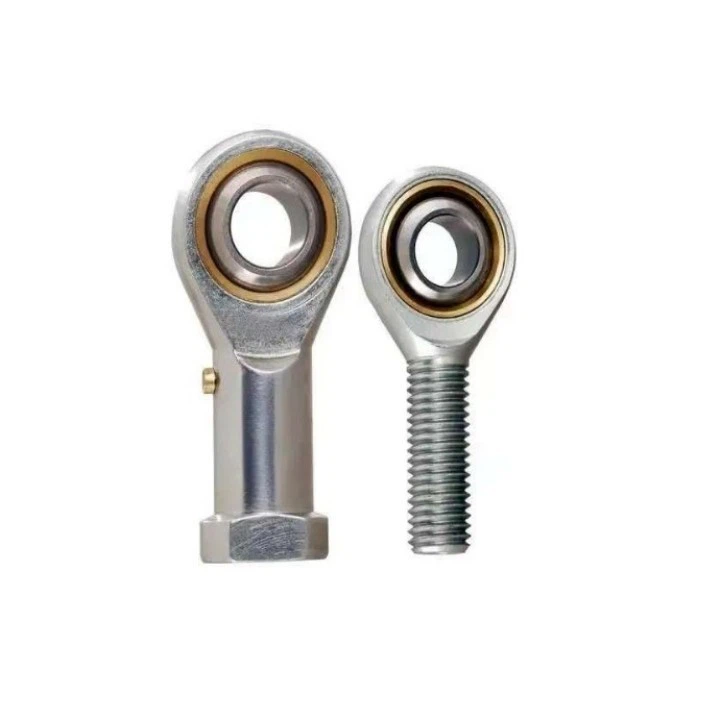
One of the key requirements in textile machinery is the ability to handle high - speed operations. Female rod end bearings are designed to handle dynamic loads and high - speed rotations. Their spherical design allows for smooth movement, reducing friction and wear. This means that they can keep up with the fast - paced nature of textile manufacturing without breaking down easily.
Another important aspect is precision. In textile production, even the slightest misalignment can lead to defects in the fabric. Female rod end bearings are engineered to provide accurate and consistent movement. They can help maintain the proper alignment of different parts of the machinery, ensuring that the fabric is produced with high quality and uniformity.
Let's talk about durability. Textile machinery often operates in harsh environments, with exposure to dust, lint, and sometimes even chemicals. Female rod end bearings can be made from various materials, such as stainless steel, which offers excellent corrosion resistance. For example, our Stainless Steel Heim Joint Rod Ends SI8 and Stainless Steel Rod End Bearings SI5 are made from high - quality stainless steel. This makes them suitable for use in textile machinery, as they can withstand the wear and tear caused by the working environment.
Maintenance is also a big deal in the textile industry. Downtime for maintenance can be costly, so it's important to have components that are easy to maintain. Female rod end bearings are relatively simple in design, which means that they can be easily inspected, lubricated, and replaced if necessary. This helps to minimize the time and cost associated with maintenance.
However, it's not all sunshine and rainbows. There are a few things to consider when using female rod end bearings in textile machinery. One is the load capacity. Different textile machines have different load requirements, and it's crucial to choose the right size and type of bearing to handle the specific loads. If the bearing is overloaded, it can lead to premature failure.
Another factor is the speed and frequency of movement. Some textile processes involve very rapid and repetitive movements. In such cases, the bearings need to be able to handle the high - frequency vibrations and impacts. It's important to select bearings that are designed for these specific operating conditions.
Now, let's look at some real - world examples. In spinning machines, female rod end bearings can be used to connect the drive shafts to the spinning elements. This allows for smooth and precise rotation, which is essential for producing high - quality yarn. In weaving machines, they can be used in the shedding mechanism, which controls the movement of the warp threads. The flexibility of the bearings helps to ensure that the shedding process is accurate and efficient.
In fabric handling systems, such as those used for cutting and folding, female rod end bearings can be used to connect the conveyor belts and the moving arms. This enables smooth and coordinated movement, reducing the risk of fabric damage.
So, to answer the question, yes, female rod end bearings can definitely be used in textile machinery. They offer a range of benefits, including high - speed performance, precision, durability, and ease of maintenance. However, it's important to choose the right bearings for the specific application, taking into account factors such as load capacity, speed, and environmental conditions.
If you're in the textile machinery business and are looking for high - quality female rod end bearings, we're here to help. We have a wide range of products to suit different needs and requirements. Whether you need a small - sized bearing for a delicate spinning machine or a heavy - duty bearing for a large - scale weaving operation, we've got you covered.
Don't hesitate to reach out to us if you have any questions or if you're interested in purchasing our products. We're always happy to have a chat and find the best solutions for your textile machinery needs. Let's work together to make your textile production more efficient and reliable.
References
- Machinery's Handbook, Industrial Press Inc.
- Textile Manufacturing Technology, John Wiley & Sons


