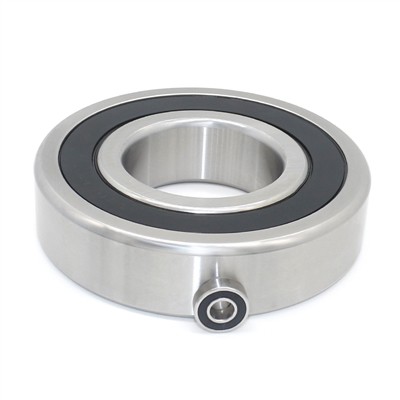
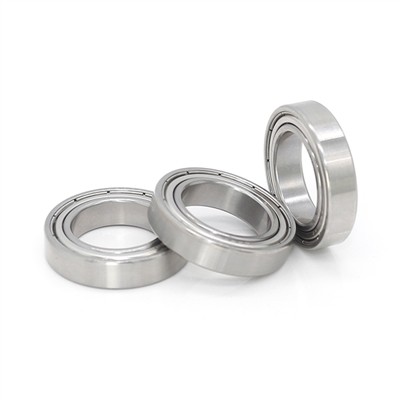
When domestic industrial robots perform precise operations in the workshop, when humanoid robots complete difficult movements such as walking and grasping, and when surgical robots achieve micrometer level precision operations... few people notice that deep inside the joints of these intelligent equipment, domestic precision bearings silently carry all movements and loads, becoming the "invisible heroes" of the robot industry's breakthrough. From being monopolized by international brands for a long time, to breaking down technological barriers and mass supplying top enterprises today, domestic robot bearings have taken ten years to overcome challenges and completed a comeback from "low-end substitution" to "high-end competition", further supporting the "key link" of China's robot industry chain's independent and controllable development.
Small bearings, big mission: the "joint heart" of robots
Robot bearings are not comparable to ordinary industrial bearings. They are the backbone, precision core, and lifespan cornerstone of robots, directly determining their motion accuracy, load capacity, stability, and service life.
A 6-axis industrial robot needs to be equipped with 30-50 sets of precision bearings; A humanoid robot with up to 20-40 sets of bearings per unit, covering core joints such as shoulders, elbows, hips, and knees. These bearings face the "four ultimate tests":
1. Ultimate accuracy: The rotation error is controlled within 1 micrometer (about 1/60 of the diameter of a human hair), and even a tiny difference can lead to motion deviation and grasping errors;
2. Ultimate load: It needs to withstand radial force, axial force, and overturning moment simultaneously, and its rigidity is 3-4 times that of traditional single row bearings;
3. Ultimate volume: Narrow joint space, bearings need to have ultra-thin cross-sections (as low as 5mm), lightweight, and balance "small size" and "large load capacity";
4. Ultimate lifespan: Industrial robots require uninterrupted operation for 7 × 24 hours, bearing lifespan needs to exceed tens of thousands of hours, and there is no wear or jamming under high-frequency reciprocating motion.
Divided by function and scenario, robot core bearings are mainly divided into five categories, each of which is a technical "hard bone":
1. Cross roller bearing: The main joint of the humanoid robot is "standard", with rollers arranged in a 90 ° cross pattern, zero backlash, high rigidity, and suitable for heavy-duty rotating scenarios such as shoulders and hips;
2. Flexible bearings for harmonic reducers: The "heart" of the reducer needs to withstand high-frequency elastic deformation, and its lifespan directly determines joint stability. The domestication rate was once less than 30%;
3. Angular contact ball bearings: the main force of high-speed joints, pre tightened installation in pairs, anti overturning, high speed, suitable for motor spindles and high-speed swinging joints;
4. Thin walled deep groove ball bearings: lightweight preferred, with a wall thickness as low as 0.2mm, suitable for dexterous hands and small joints, balancing low noise and high precision;
5. Self lubricating joint bearings: the "king of maintenance free" in harsh working conditions, suitable for high temperature, low temperature, and corrosive scenarios, with no jamming during large angle deflection.
Breaking through the bottleneck and tackling challenges: from being "stuck" to being "autonomous and controllable"

Once, the global high-end robot bearing market was monopolized by overseas giants such as THK from Japan and SKF from Sweden. The import dependence of high-end bearings for industrial robots in China exceeded 70%, and the special bearings for humanoid robots were almost completely dependent on imports, becoming a bottleneck problem that constrained the development of the industry.
After ten years of sharpening a sword, under the pressure of policy support and market demand, domestic bearing enterprises have devoted themselves to research and development, overcome core technologies, and achieved breakthroughs in the entire chain from materials, processes to mass production.
1. Material Breakthrough: From "High Impurity" to "High Purity." Materials constitute the fundamental basis for bearing longevity.
Domestic manufacturers have successfully mastered the smelting technology for high-purity bearing steel. By strictly controlling impurity levels and optimizing the metallographic structure, they have enhanced the steel's fatigue strength and thermal stability, thereby resolving-at the very source-critical issues such as pitting and spalling.
• Exclusive formulations for specialized bearing steels, specifically tailored to withstand the high-impact conditions associated with the rapid forward and reverse rotation cycles of robotic systems;
• A gradient heat treatment process that achieves a surface hardness of 62 HRC while preserving core toughness, resulting in a substantial enhancement of impact resistance.
2. Process Breakthrough: From "Rough Machining" to "Nanoscale Precision Control." Precision machining lies at the very heart of accuracy; domestic manufacturers have successfully overcome three major bottlenecks: ultra-precision grinding, nanoscale surface treatment, and thin-wall machining.
• Crossed Roller Bearings: Achieving a rotational accuracy of ±0.001 mm and a 50% increase in rigidity, thereby rivaling high-end imported products;
• Ultra-Thin-Wall Bearings: Controlling wall thickness tolerances within ±0.01 mm-with minimum thicknesses reaching just 0.2 mm-to realize the ideal combination of "thin yet strong";
• Flexible Bearings: Successfully resolving the challenge of maintaining precision under high-frequency deformation conditions; standard service life now exceeds 12,000 hours, fully meeting the rigorous demands of harmonic reducers.
3. Rise of Enterprises: Segmented Leaders Support the "Domestic Matrix". Nowadays, a "head concentrated, segmented leading" robot bearing industry pattern has been formed in China. BLH bearings stand out and provide bulk supply to leading enterprises such as Green Harmonic, Yushu Technology, Zhiyuan Robotics, and Ubiquitous.
Our robot bearings have the following characteristics:
The "invisible champion" of cross roller bearings for humanoid robots has a domestic market share of over 90%, with an accuracy of 1 micron and lifetime maintenance free;
RV/harmonic reducer bearing core supplier, 0.8mm ultra-thin wall bearing achieves mass production, with a year-on-year revenue growth of 194% in 2025;
Self lubricating bearing faucet, with a friction coefficient as low as 0.03, a lifespan of over 15000 hours, and a cost 35% lower than imported products; •
The main force of industrial robot heavy-duty bearings, double row angular contact bearings, and cross roller bearings are suitable for heavy-duty robotic arms, with 10000 hours of fault free operation.
The rise of domestic robot bearings is not solely based on "low prices", but has formed three core advantages on the basis of performance comparable to imports, deeply meeting the needs of the domestic robot industry.
1. Comparable in performance and superior in price. After years of iteration, domestic bearings have reached the same level of precision, rigidity, and service life as imported bearings, and some indicators have even surpassed them; The price is only 60% -70% of imported brands, significantly reducing the overall cost of robots and helping domestic robots enhance their market competitiveness.
2. Localized adaptation and strong customization capabilities. Domestic enterprises deeply cultivate the domestic robot scene and can quickly respond to the customized needs of complete machine manufacturers: • Customize exclusive repair solutions for different force characteristics of reducers (RV/harmonic); Adapt to different industry conditions such as 3C, automotive, photovoltaic, medical, etc., and provide an integrated solution of "bearing+installation+maintenance".
3. Quick response, full cycle service. Overseas brands have long after-sales response cycles and high maintenance costs; Domestic enterprises relying on localized production bases can achieve 24-hour technical response, 48 hour on-site service, and 7-day fast delivery, significantly reducing robot downtime maintenance costs and ensuring efficient operation of production lines.