Introduction
The urgent need to address environmental issues such as climate change has driven the widespread adoption of electric vehicles (including hybrids). One of the primary bottlenecks hindering the large-scale rollout of these low-environmental-impact models is the need to extend their driving range. To maximize the efficiency of both fuel and electrical energy utilization, electric vehicle drive units must be designed to be more compact, lightweight, and highly efficient. Furthermore, the miniaturization of drive units offers greater design flexibility regarding both cabin layout and overall vehicle styling.
Motor miniaturization is a key strategy for reducing the overall size and weight of drive units. Since motor output power is the product of torque and rotational speed, maintaining performance within a miniaturized package necessitates increasing the motor's rotational speed. Consequently, the deep groove ball bearings utilized in electric vehicle motors must while maintaining a compact structure deliver enhanced performance characterized by higher rotational speeds and lower friction.
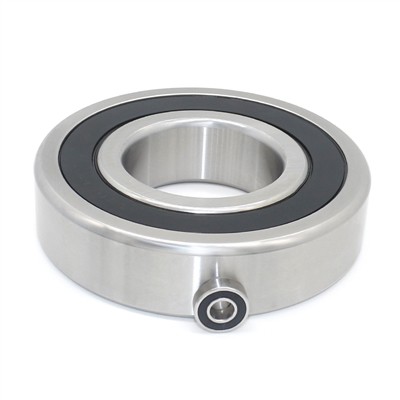
The mainstream structural configurations for electric vehicle drive units-specifically, the reducers within electric drive axles-fall into two categories: the parallel three-shaft type and the two-shaft/coaxial type (Figure 1). While the current market is dominated by the structurally simpler parallel three-shaft electric drive axle, the market adoption trend for the two-shaft/coaxial design continues to rise due to its ability to reduce overall vehicle length and lower the height of the drive unit. Because components in the two-shaft/coaxial structure are arranged coaxially, the bearings employed must not only be miniaturized, capable of high-speed operation, and low-friction, but also significantly narrower in width. To meet these evolving requirements, we have developed a compact, lightweight deep groove ball bearing specifically designed for electric vehicles (Figure 2).
The core challenge of two-axis / coaxial structures is that the coaxial arrangement of the motor, input shaft, and output shaft leads to:
→ A tendency for the overall shaft length to increase compared to parallel three-axis designs; this, in turn, necessitates:
→ The development of supporting bearings toward a narrower profile.


Characteristics of Compact, Lightweight Deep Groove Ball Bearings for Electric Vehicles
Our engineers have achieved a significant reduction in bearing size and weight by using a newly developed narrow combined plastic cage, combined with existing specialized technology. Compared with traditional products, the new bearing has a 10% reduction in outer diameter, a 38% reduction in width, a 51% reduction in weight, and a 25% reduction in torque (Figure 3). The following provides a detailed explanation of the core technology used in this bearing.

Narrow combined plastic cage
Deep groove ball bearings for high-speed working conditions usually use plastic retainers. The traditional crown shaped plastic cage (Figure 4) is assembled on one side and is prone to deformation under high-speed conditions. If the maximum speed is exceeded, problems such as the bottom of the cage pocket breaking or contact damage with the outer ring may occur. The conventional solution is to thicken the bottom of the pocket, but it will cause the bearing width to increase synchronously with the total length of the drive unit shaft.

Based on industry demand, we have designed a narrow combined plastic cage for mold opening (Figure 5) that can suppress deformation risk without increasing the thickness of the bottom of the pocket hole. The cage adopts a double-sided mating structure to form a rigid annular whole, and the bottom of the pocket can be designed to be thinner than the crown shaped cage, achieving narrowing of the bearing and shortening of the drive unit shaft length.

Solution to the reduction of static strength caused by the miniaturization of bearings
The main drawback of miniaturization of ball bearings is that their ability to withstand impact loads may decrease. Under the action of axial impact, the steel ball is prone to climb up the groove shoulder of the raceway and form indentation, which can accelerate surface fatigue and shorten the bearing life. To avoid this problem, the new compact lightweight deep groove ball bearing adopts a special smooth curved groove shoulder structure, which can prevent the steel ball from being pressed under impact conditions (Figure 6).

In addition, indentation caused by strong impact loads can reduce the acoustic performance and durability of bearings (Figure 7). Our automotive industry specific deep groove ball bearings have undergone rigorous testing to clarify the impact of indentation on performance, achieving more accurate and highly reliable strength design.

The solution to reducing fatigue life caused by miniaturization of bearings
There is also a risk of reduced fatigue life of bearings in miniaturization. Research has shown that an increase in surface roughness during the use of steel balls can accelerate fatigue on the raceway surface. My bearing manufacturing factory uses a special heat treatment process to treat steel balls, maintaining surface smoothness and extending their lifespan (Figure 8).

Meanwhile, the traditional calculation of the dynamic basic rated load Cr (bearing capacity index) is only based on size parameters such as groove curvature radius. The new type of bearing adopts a Cr calculation method that considers the actual contact state between the steel ball and the ring, improving the accuracy of life prediction.
High Speed Rotational Performance of Compact, Lightweight Deep Groove Ball Bearings for Electric Vehicles
Through the design of a new retaining frame and rigid reinforcement, the bearing achieves a significant increase in allowable speed on the basis of lightweight and low friction. After testing, it was found that under high-speed conditions with a DMN value of 2.14 million (the upper limit of traditional specifications is 1.8 million), the bearing did not experience any failure such as cage damage or internal jamming, and passed the test smoothly (Figure 9).

Advantages of using compact bearings in electric vehicles
Applying compact and lightweight deep groove ball bearings to electric vehicle drive units can achieve a more compact, lightweight, and shorter shaft length, directly improving the efficiency of electric energy utilization. For example, when the bearing is applied to a coaxial electric drive axle (Figure 10), the unit shaft length is shortened by 16mm, the weight is reduced by 2.2kg, and the electrical energy efficiency is increased by 0.09% (energy consumption per kilometer of travel). This efficiency improvement can reduce battery costs by 960 yen ¹ and increase the range by 370m ². If applied to the output shaft at the same time, the shaft length is shortened by 32mm, the weight is reduced by 4.4kg, the power efficiency is improved by 0.14%, the battery cost is saved by 1665 yen ¹, and the range is increased by 590m ². This product is not only suitable for coaxial electric drive axles, but also for various types of electric vehicle powertrain systems such as parallel three-axis electric drive axles, folding two axis electric drive axles, hybrid vehicle drive units (DHT), etc.
Conclusion
Compact and lightweight deep groove ball bearings for electric vehicles have achieved significant breakthroughs in miniaturization, low friction, and high speed by integrating new narrow width plastic cages with mature technology. This bearing is not only suitable for electric drive axles and DHT, but also for traditional transmissions and non automotive fields, helping various industries achieve efficient and compact design.