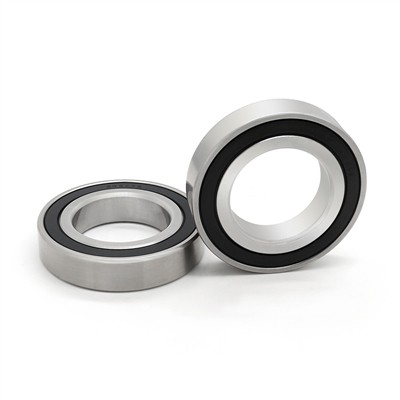
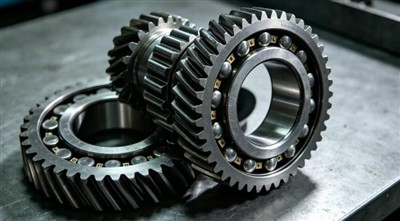
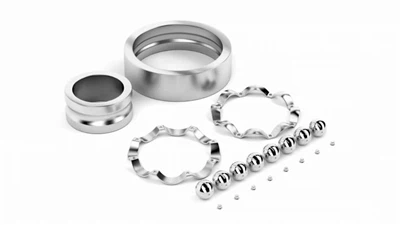
Small bearings, big dreams, production process of stainless steel deep groove ball bearings
Customers often ask how amazing it is that such a small bearing can rotate at 50000 revolutions per minute. How is such a precise small bearing manufactured?
Here are some common questions summarized by our bearing engineers to answer everyone.
Answer: The purpose is to increase the hardness of the ring material (such as GCr15) to 58-62HRC through heating, insulation, and cooling processes, ensuring that the bearing will not deform or wear under high-speed rotation and conditions.
Answer: The core difference lies in accuracy and surface smoothness
A "light ball" is a process of using a grinding wheel to remove the excess material from the steel ball blank, allowing the steel ball to initially form;
Grinding ball "refers to the precise polishing of steel balls after polishing with abrasives, achieving micrometer level roundness errors and mirror level surface roughness.
Answer: It is necessary to focus on controlling the radial clearance (the maximum distance of relative radial movement between the inner and outer rings of the bearing). The control method is to select different specifications of "retainers" and "adjust the grooves of the inner and outer rings" according to the design requirements, ensuring that the clearance is within the standard range. For example, the C0 clearance of the bearing 6000ZZ is 0.005~0.015mm
Answer: Cleaning before heat treatment is to remove oil stains and iron filings on the surface of the bearing ring, and to prevent impurities from infiltrating the material and affecting its hardness during heating; Cleaning after heat treatment is to remove the oxide layer on the surface and prevent scratching the bearing or affecting assembly accuracy during subsequent processing.
Answer: Three types of problems can be identified:
1. Surface defects (such as pitting and scratches) on the grooves of steel balls and rings;
2 is assembly deviation (such as looseness of retainers, clearance size, noise level);
3 is accuracy deviation (such as non-conforming ring roundness and coaxiality).

How's it going? Dear friends, through the above Q&A, have you gained a preliminary understanding of bearing production? The following article will provide a detailed introduction to the entire process of deep groove ball bearings from raw materials to finished products. If you would like to learn more about bearings, please feel free to contact us.
Production process of stainless steel deep groove ball bearings
Raw materials - inner and outer ring processing, steel ball or roller processing, cage (stamping or solid) processing - bearing assembly - bearing finished products. In the bearing production process, the most critical steps are as follows
Forging links
The forging process is an important step in ensuring the reliability and lifespan of bearings. After forging the raw materials, a bearing ring blank is formed. At the same time, the structure of raw materials becomes denser and more streamlined, which can improve the reliability and service life of bearings. In addition, the quality of forging technology will directly affect the utilization rate of raw materials, thereby affecting production costs.
heat treatment process
Heat treatment process is the high-temperature treatment of forged and machined bearing rings, which directly affects the uniformity of carburizing of bearing rings, can improve the wear resistance and hardness of bearings, and also affects the reliability and service life of bearings. Bearing. Important part.
grinding process
The bearing ring after heat treatment also needs to be ground, which is an important step to ensure the accuracy of the bearing. After grinding, the production process of bearing rings is basically completed.

Process flow of inner and outer rings of bearings
Bar forging turning heat treatment grinding ultra precision machining final inspection of parts rust prevention storage
The main production equipment includes: cold rolling mill, fully automatic ball bearing internal cylindrical grinder, quenching wire, annealing furnace, press machine, CNC lathe, bearing grinder, inner groove grinder, outer groove grinder, high-precision horizontal axis worktable surface grinder, CNC milling machine, centerless grinder, high-precision full grinding centerless grinder, precision groove ultra precision machining machine, inner surface CNC grinder, CNC reciprocating double end face grinder, high-temperature and high-speed bearing testing machine, heat treatment production line and quality inspection equipment, etc
Basic production process of rolling bearings
Due to the different types, structures, tolerance levels, technical requirements, materials, and batches of rolling bearings, their basic production processes are not completely the same.
Processing technology for various main components of bearings
The processing technology of the ring: The processing of the inner and outer rings of the bearing varies depending on the form of the raw material or blank. The pre turning process can be divided into the following three types. The entire processing process is as follows: bar or tube (some bars require forging, annealing, and normalizing) - turning processing - heat treatment - grinding processing - precision grinding or polishing - final inspection of parts - rust prevention - storage - (to be assembled)
The processing of steel balls also varies depending on the condition of the raw materials. Among them, the processes before filing or light balling can be divided into the following types, and the processes before heat treatment can also be divided into the following types. The entire processing process is: cold stamping of bars or wires (some bars require stamping and annealing after cold stamping) - filing, rough grinding, soft grinding or light balling - heat treatment - hard grinding - fine grinding - fine grinding or grinding - final inspection grouping - rust prevention, packaging - storage.
The processing technology of rollers varies depending on the raw materials used. The process before heat treatment can be divided into the following two types. The entire processing process includes: bar turning or wire cold heading, ring threading, soft grinding - heat treatment - threading soft points - rough grinding of outer diameter - rough grinding of end face - final grinding of end face - fine grinding of outer diameter - final grinding of outer diameter - final inspection grouping - rust prevention, packaging - storage (to be assembled together).
The processing technology of retaining frames can be divided into the following two categories according to the design structure and raw materials:
(1) Sheet material → cutting → punching → stamping → shaping and finishing → acid washing or shot blasting or wire drawing → final inspection → rust prevention and packaging → warehousing (complete assembly)
(2) The processing process of the solid cage: The processing of the solid cage varies depending on the raw materials or the damage. Among them, it can be divided into the following four types of blanks before turning. The whole processing process is: bar, Tube material, forgings, castings ---- inner diameter, outer diameter, end face, chamfering ---- drilling (or pulling hole, boring) ---- pickling ---- final inspection ---- Anti-rust, packaging - storage .
Assembly process of rolling bearings
Rolling bearing components such as inner and outer rings, rolling elements, and retainers, after passing inspection, enter the assembly workshop for assembly. The process is as follows:
Parts demagnetization, cleaning → inner and outer rolling channel size grouping and sorting → fitting → checking clearance → riveting cage → final inspection → demagnetization, cleaning → rust prevention, packaging → entering the finished product warehouse (packing, shipping >.
For bearings used in special environments, BLH Bearing Factory starts with raw materials and improves manufacturing processes to ensure that bearings can be used in harsh environments without any problems.
Our bearing product features:
High temperature resistance,
Strong acid and alkali resistance
High speed, low noise
High precision, maintenance free