

Since we started producing bearing rings 50 years ago, our factory has been contributing to the development of various industries.
Now, as a comprehensive bearing manufacturer, we meet various needs of users in a wide range of fields.
Below, let me briefly introduce the knowledge about bearings.

Hook and function of bearings
Bearings are actually all around us, and their usage is astonishing.
Taking cars as an example, a car usually requires 100 to 150 bearings. Without bearings, the wheels will creak, the gears of the gearbox will not mesh, and the car will not be able to travel.
Not only cars, but also railway vehicles, airplanes, washing machines, refrigerators, air conditioners, vacuum cleaners, copiers, computers, and even artificial satellites flying in distant space, all have the presence of bearings. Bearings play an important role in improving mechanical operating efficiency and energy conservation. Unfortunately, due to the silent operation of bearings inside the machinery, people rarely have the opportunity to directly see the true face of bearings. But bearings are indeed important components that maintain mechanical stability and function effectively.
The English name for a bearing is "Bearing", which means to support or bear. In Japanese, bearings are written as' shaft bearings' because they are used to support a rotating shaft, meaning 'supporting a rotating shaft'.
The bearing shown in the photo below is the most basic "Rolling Bearing".
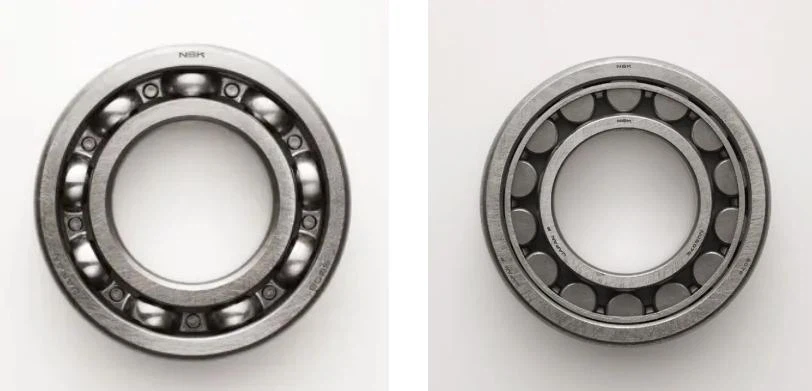
The basic structure of a rolling bearing is simple, consisting of four parts. As shown in the figure below

The basic function of bearings is to reduce mechanical friction. Reducing friction has three major benefits
Improve the efficiency of mechanical work.
Extend the service life of machinery.
Prevent biting and reduce mechanical failures.
Bearings can reduce friction, improve transmission efficiency, and contribute to energy conservation. This is why people often say 'bearings are environmentally friendly'.
The origin of bearings
Around the 8th century BC, the ancient Mesopotamians already understood the basic principles of using modern rolling bearings. The following picture is derived from Mesopotamian reliefs.
Afterwards, the genius painter Leonardo da Vinci in the Middle Ages designed rolling bearings that were very similar in structure to modern bearings, and the mechanical civilization born in the 18th century industrial revolution promoted the development of bearings.
In 1916, Mr. Seiko of Japan produced the first set of rolling bearings, and Japan's bearing technology made great progress after World War II. Starting from 1955, household appliances such as washing machines, refrigerators, air conditioners, and family cars gradually became popular. At this time, an important performance indicator proposed by the Japanese for household appliances is "quietness". At this time, foreign companies do not attach importance to the "silent" performance of bearings. Therefore, Japanese bearing companies aim to develop products with the goal of "manufacturing the world's quietest bearings". The final result was that Japanese bearings with excellent noise reduction performance began to be exported to Europe and America. Afterwards, Japanese bearings also had good "durability".
The specifications of the bearings are developed by ISO (International Organization for Standardization) as an international standard. Our bearings are highly favored by users worldwide for their "high performance, high quality" characteristics. At present, China produces about 3.5 billion sets of bearings annually, of which over 48% are automotive bearings and nearly 30% are exported overseas.
As a globalized product, the development of bearings often needs to exceed the requirements of the times. In the future, continuous research on reducing friction is still needed. At the same time, in terms of lightweight, miniaturization, long life, and energy conservation and environmental protection, new challenges are constantly being met.
The world of bearings seen from numbers
Sizes range from 2 millimeters to 6 meters.
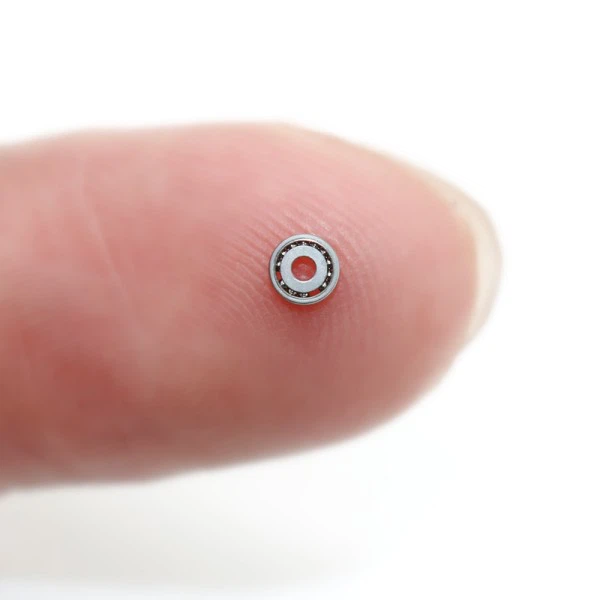
Bearings vary greatly in size from small to large. The world's smallest "miniature bearing" has an inner diameter of 0.6mm, an outer diameter of 2.0mm, and a thickness of 0.8mm, and is used in miniature motors. And large bearings, with an outer diameter of 6 meters and a weight of over 15 tons, are used in large shield tunneling machines for tunnel excavation. When excavating a cross sea tunnel under the Dover Strait connecting England and France, this type of shield machine was used, including the use of this large bearing.
400,000 revolutions per minute
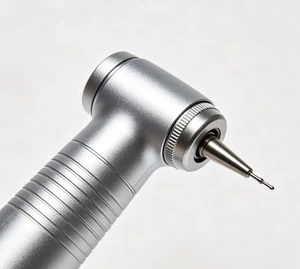
Dental drills (commonly known as dental phones) used by dentists are equipped with bearings that can rotate at ultra-high speeds. These are two ultra precision bearings with an inner diameter of 3.0mm, an outer diameter of 6.0mm, a width of 2mm, and a steel ball diameter of 1.0mm. They can rotate at an astonishing speed of '400000 revolutions per minute', greatly reducing the vibration of dental phones and greatly alleviating the pain of patients during treatment.
Steel ball speed of 160 meters per second
The V2500 jet engine of international airline aircraft uses main shaft bearings, and its rolling elements have a rolling speed of 160 meters per second, equivalent to a speed of 580 kilometers per hour. It is precisely because of the use of high-performance high-speed bearings that the engine can operate safely for a long time and safely transport passengers around the world.
Amplitude below 100 nanometers
The precision of machinery depends on the rotational accuracy of bearings, which is not an exaggeration. The two ends of the rotating shaft are supported by two bearings. If the axis shakes greatly, the mechanical performance cannot be improved. A computer external storage device, also known as a "hard disk," using ultra precision bearings, has an axial amplitude of less than 100 nanometers (1 nanometer=1/1000000 millimeters). The key to achieving such ultra-high precision is the accuracy of rolling elements such as "steel balls" and "rollers".
Can work in space for 20 years
Space development also relies on bearings. Weather forecasts, satellite radio and television signals, and car satellite positioning information are all provided by artificial satellites orbiting the Earth. The satellite is equipped with a gyroscope that maintains its attitude and heading, and the gyroscope contains ultra precision bearings. This type of bearing can work continuously in space for 20 years.
A world from minus 253 degrees Celsius to over 500 degrees Celsius
The bearings in the liquid fuel pump of space rockets are the bearings with the lowest operating temperature. This type of bearing operates in liquid hydrogen at minus 253 ℃. The bearings used in high-temperature environments are typically represented by high-performance bearings specifically designed for medical CT scanners. In X-ray vacuum tubes with temperatures ranging from 300 to 500 ℃, bearings can also operate continuously, playing a role in ensuring our health.
The future of bearings
Finally, let me introduce the challenges faced by the development of bearings.
Firstly, it is more energy-efficient. The smaller the machine, the smaller the components that make up it. Moreover, the smaller and more precise the machinery, the smaller the friction, the more likely it is to cause malfunctions. Furthermore, on a global scale, no matter how small the machinery is, the total amount of energy loss is still quite significant. Therefore, in order to be more energy-efficient, bearings must also develop towards further reducing friction.
Secondly, it is more 'environmentally friendly'. Bearings placed inside machinery can also reduce exhaust emissions from vehicles and achieve environmental protection effects. In addition, most bearings are made of steel materials that do not contain harmful chemicals, so they can be recycled and reused, and the smelting process is relatively simple. Therefore, bearings are very good renewable and reusable products.
Thirdly, it is more comfortable. The purpose of manufacturing machinery is to make human life more comfortable. In the past, machinery was mainly used to improve production efficiency. In the future, machinery will play a greater role in social and personal life such as education, healthcare, and entertainment. Therefore, new and higher requirements will be put forward for the function and use of bearings. The three topics listed above are the long-term research and development work that our bearing factory has been committed to for the harmonious coexistence of "humanity and the earth", and they are also the work that we will continue to delve into in the future.
Here are the three topics mentioned above, and we will continue to devote ourselves to research and development work for the sake of "humanity and the earth" in the future.


