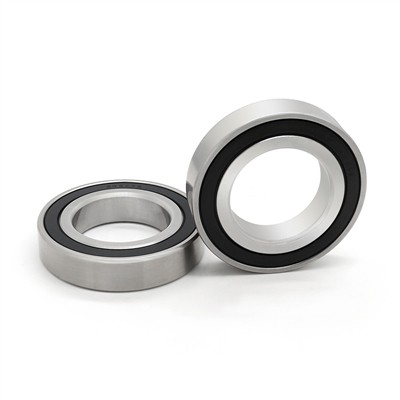
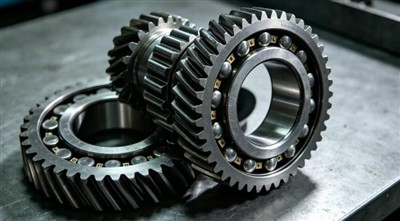
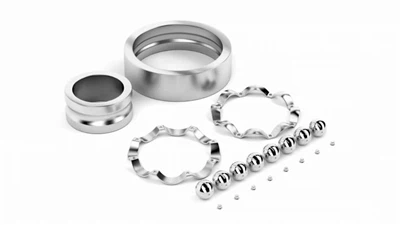
The inner ring of the bearing crawls (rotates) on the shaft neck

Considerations for cooperation or peristalsis:
►In most applications, the axis rotates and the load on the axis is unidirectional. This load is considered as the rotational load of the inner ring, requiring a tight (interference fit) fit between the inner ring and the shaft to prevent relative movement. The good operation of bearings largely depends on proper fit.
►However, if the journal size is too small or worn, the inner ring will creep or rotate on the journal.
►This will lead to increased noise, vibration, and wear.
Measures:
Perform surface metal treatment on the journal and grind it to the appropriate size.
The outer ring of the bearing crawls (rotates) inside the bearing seat hole

Considerations for cooperation or peristalsis:
►Most applications have stationary bearing seats, and the load on the bearing seat is unidirectional. This type of load is considered as a static load on the outer ring, and in most cases, the outer ring can be properly positioned using a clearance fit.
►However, if the bearing seat hole is too large or worn, the outer ring will creep or rotate inside the bearing seat hole.
►This will lead to increased noise, vibration, and wear.
Measures:
►Perform surface metal treatment on the bearing seat hole and grind it to the appropriate size.
►For large bearing seats, machining enlarged bearing seat holes and adding bushings for use is also a solution.
Unbalanced load distribution
Factors to consider in terms of convergence or peristalsis:
►Even with proper coordination, the load generated by shaft imbalance can cause the outer ring to creep.
If you would like to learn more details, please feel free to contact me at any time.
Email: jackengineer@blhbearing.com
WhatsApp:+8613760352799
www.blhbearing.com