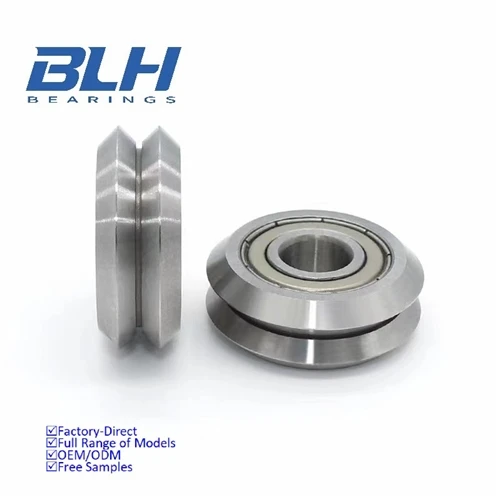
High Precision Plastic Ball Bearings Manufacturer
Product Introduction
Plastic ball bearings are used in equipment where conventional metal bearings may not be suitable due to moisture, chemical exposure, magnetic requirements, or restrictions on grease lubrication.
BLH BEARINGS manufactures custom plastic ball bearings using engineering plastics such as POM, PP, PA66, and PEEK. Depending on the application, the inner and outer rings can be combined with glass balls, ceramic balls, or 316 stainless steel balls to meet different operating requirements.
Unlike standard steel bearings, plastic bearings offer several practical advantages: they are lightweight, resistant to many corrosive substances, electrically insulating when designed with non-conductive components, and suitable for grease-free operation in applications where the load and speed allow it.
Material selection is important. A bearing designed for a food processing conveyor, for example, may require a different combination from one used in a chemical dosing system or an underwater cleaning device.
At BLH, we evaluate the working environment before recommending a material combination. Customers can provide drawings, samples, operating temperatures, loads, rotational speeds, and chemical exposure details for engineering review.
Looking for a custom plastic bearing? Contact BLH to discuss your application, material requirements, and sample options.
Technical Specifications & Material Selection Guide
Different engineering plastics have different mechanical, thermal, and chemical properties. Choosing the right combination of ring, cage, and ball materials helps determine how a plastic ball bearing performs in service.
BLH offers the following material combinations as starting points for application evaluation. Final operating limits depend on the specific material grade, bearing dimensions, internal clearance, load, speed, and surrounding conditions.
| Material Grade | Inner & Outer Ring | Cage Material | Ball Material | Indicative Temperature Range | Main Characteristics |
|---|---|---|---|---|---|
| General-Purpose Grade | POM (Acetal) | PA66 / PTFE | Glass / 316 Stainless Steel | -40°C to +100°C | Good dimensional stability, rigidity, and wear resistance |
| Chemical-Resistant Grade | PP (Polypropylene) | PP / PTFE | Glass / Ceramic | -20°C to +90°C | Resistance to many acids, alkalis, and corrosive environments |
| High-Strength Grade | PA66 (Nylon 66) | PA66 | Glass / Stainless Steel | -40°C to +120°C | Good mechanical strength, impact resistance, and wear performance |
| High-Temperature Grade | PEEK | PEEK / PTFE | Zirconia / Silicon Nitride | -60°C to +250°C | High thermal stability, chemical resistance, and dimensional performance |
Note: The temperature ranges above are indicative material selection references, not guaranteed continuous operating limits for every bearing configuration. Please confirm the actual material grade and application conditions with BLH engineering before placing an order.
Understanding the Main Bearing Materials
POM (Acetal)
POM is commonly selected for plastic ball bearings because it offers a useful balance of rigidity, dimensional stability, wear resistance, and machinability. It is suitable for many general industrial applications, including food-processing equipment where an appropriate food-contact grade is specified.
PP (Polypropylene)
PP is often considered when chemical resistance is a major concern. It performs well in many acid and alkali environments and has relatively low moisture absorption. The exact chemical compatibility should still be checked against the concentration, temperature, and exposure time of the working medium.
PA66 (Nylon 66)
PA66 provides good mechanical strength and impact resistance. It can be used in applications requiring stronger polymer components, although moisture absorption needs to be considered when dimensional stability is important.
PEEK (Polyetheretherketone)
PEEK is a high-performance engineering plastic used in applications requiring a combination of thermal stability, chemical resistance, and mechanical performance. It is often considered for demanding industrial, laboratory, and specialized medical equipment.
Core Manufacturing Advantages of BLH Plastic Bearings
Plastic bearings require careful control of dimensions and material properties. A small change in ring geometry or internal clearance can affect rotation, noise, and service life.
BLH focuses on the following manufacturing capabilities:
1. Precision CNC Machining
BLH uses CNC turning to machine engineering plastic components according to bearing design requirements. This approach allows dimensions and bearing structures to be adjusted for different applications, including non-standard designs.
For custom orders, machining requirements are evaluated against the customer's drawings, material selection, and intended operating conditions.
2. Material Combinations for Grease-Free Applications
One reason customers consider plastic ball bearings is the possibility of operating without conventional grease lubrication.
Engineering plastics can offer favorable friction characteristics, but grease-free operation depends on the polymer, ball material, bearing structure, load, speed, and operating environment. BLH can evaluate suitable combinations for applications where grease contamination or lubricant maintenance is a concern.
3. Lightweight Bearing Construction
Engineering plastics are generally much lighter than bearing steel. Replacing selected metal bearing components with polymer components can reduce the weight of a moving assembly and help lower rotational inertia.
This can be useful in equipment with frequent starting and stopping, lightweight conveyor mechanisms, and compact drive systems.
4. Custom OEM and ODM Manufacturing
BLH supports standard-size and customized plastic bearing requirements.
Available design options include:
Plastic deep groove ball bearings
Custom-size plastic ball bearings
Flanged plastic bearings
Grooved plastic bearing rollers
U-groove and V-groove roller assemblies
Common size references include 608, 6200, and 6900 series configurations. Final dimensions and compatibility need to be confirmed according to the actual design.
Customers can submit CAD drawings, physical samples, or application specifications for evaluation.
Top 3 Application Industries & Field Solutions
Plastic ball bearings are not intended to replace steel bearings in every application. Their value becomes more apparent when equipment operates in environments where corrosion resistance, low weight, electrical insulation, or reduced lubrication requirements are important.
The following industries represent practical application areas for different plastic bearing configurations.
1. Food, Beverage & Packaging Machinery
Typical Equipment:
Beverage filling and bottling lines
Food sorting conveyor systems
Bottle washing machines
Food packaging equipment
Labeling machines
Food processing conveyors
Common Operating Challenges:
Food and beverage equipment is frequently exposed to water, cleaning agents, and sanitation procedures. Metal bearings may require additional corrosion protection, while conventional grease lubrication needs to be managed carefully in areas close to food products.
BLH Material Recommendation:
POM plastic ball bearings are worth considering for suitable light-load conveyor and guiding applications. Depending on the equipment design, glass balls or 316 stainless steel balls can be selected.
Where food contact is involved, the exact polymer grade and relevant components must meet the applicable food-contact requirements. Compliance should be confirmed through material documentation rather than assumed from the POM designation alone.
For equipment exposed to frequent cleaning, chemical compatibility and sealing or shielding requirements should also be evaluated.
2. Water Treatment, Pool Equipment & Marine Applications
Typical Equipment:
Robotic pool cleaners
Swimming pool circulation equipment
Aquarium filtration systems
Water treatment equipment
Aquaculture machinery
Marine and water-park mechanisms
Common Operating Challenges:
Continuous exposure to water, chlorine-containing cleaning chemicals, and saltwater can accelerate corrosion in conventional metal bearing components.
For submerged applications, material selection must also account for water absorption, dimensional changes, internal clearance, and the possibility of abrasive particles entering the bearing.
BLH Material Recommendation:
PP plastic ball bearings are a potential option for applications requiring resistance to many corrosive media and relatively low moisture absorption.
POM may also be considered where its mechanical properties and chemical compatibility meet the application requirements.
Glass balls or suitable ceramic balls can be selected according to the required load, corrosion resistance, and operating conditions.
For long-term underwater use, BLH recommends evaluating the complete bearing assembly rather than selecting a material based on corrosion resistance alone. Load, rotational speed, water temperature, and chemical concentration should all be considered.
3. Medical Devices & Laboratory Equipment
Typical Equipment:
Laboratory analysis instruments
In-vitro diagnostic equipment
Medical equipment adjustment mechanisms
Laboratory mixing systems
MRI-compatible auxiliary mechanisms
Precision instrument sliding assemblies
Common Operating Challenges:
Some medical and laboratory equipment requires non-magnetic components, low operating noise, and materials compatible with controlled environments.
Conventional steel bearings may not be appropriate in applications where magnetic attraction is restricted. However, the magnetic properties of a complete bearing assembly depend on every component, including the balls, cage, fasteners, and surrounding hardware.
BLH Material Recommendation:
Plastic bearings with polymer rings and glass or ceramic balls can be considered for applications requiring non-metallic or electrically insulating bearing components.
For higher-temperature or more demanding applications, PEEK rings may be evaluated.
The final material combination should be checked against the equipment's magnetic, cleanliness, temperature, and mechanical requirements. Cleanroom suitability and medical-device compliance must be validated through the relevant testing and documentation.
Typical Application Scenarios
The following examples illustrate how different plastic bearing configurations can be evaluated for industrial equipment. They are application references, not claims of independently verified customer performance.
Application 1: Plastic Bearings for Beverage Conveyor Equipment
In beverage packaging lines, guide rollers and conveyor mechanisms may be exposed to water and cleaning chemicals.
A POM bearing with glass balls can be considered where low weight, corrosion resistance, and grease-free operation are important. The bearing dimensions, internal clearance, and ball material should be selected according to the roller structure and actual operating load.
Application 2: Plastic Bearings for Robotic Pool Cleaners
Pool cleaning equipment operates in chlorinated water and may encounter sand or other fine particles.
A PP bearing with glass balls may be suitable for selected low-load drive or guide mechanisms. Before production, the material combination should be evaluated for water exposure, chemical concentration, rotational resistance, and dimensional stability.
Application 3: PEEK Plastic Bearings for Precision Equipment
Certain laboratory and specialized medical equipment requires lightweight components and carefully controlled magnetic properties.
A PEEK bearing with ceramic balls can be considered when the application requires a high-performance polymer structure. The final assembly should undergo the necessary mechanical and application-specific validation before being adopted for long-term production.
Why Partner with BLH BEARINGS?
Selecting a plastic bearing supplier involves more than comparing prices. Material consistency, machining capability, design flexibility, and communication during product development all affect the final result.
BLH provides the following support for industrial buyers:
1. Application-Based Engineering Support
Our engineering team evaluates bearing requirements according to load, RPM, operating temperature, chemical exposure, and installation conditions.
Rather than recommending the same material for every application, we help customers compare suitable polymer and ball combinations.
2. Manufacturing and Quality Inspection
BLH focuses on dimensional consistency, bearing clearance, rotational smoothness, and product appearance during production inspection.
Inspection requirements can be discussed according to the bearing design and customer's quality specifications.
3. OEM and ODM Customization
For equipment manufacturers and industrial distributors, BLH can evaluate custom bearing designs based on drawings, samples, and technical specifications.
Material combinations, dimensions, flange structures, and grooved roller designs can be discussed according to the intended application.
4. Sample Evaluation Before Mass Production
For new designs, sample evaluation allows customers to check bearing fit, rotation, and compatibility with their equipment before moving to larger production quantities.
Sample availability, development time, MOQ, and production lead time depend on the selected material and design.
Looking for a plastic ball bearing manufacturer for your next project?
Send BLH your drawings, bearing dimensions, or application details. Our team can help review the design and recommend a suitable material combination for your equipment.
Frequently Asked Questions (FAQ)
Q1: What is the load capacity of plastic ball bearings compared with metal bearings?
Plastic ball bearings generally have lower load capacity and stiffness than comparable steel bearings. They are more commonly considered for light-load and selected medium-load applications.
The actual load capacity depends on the polymer grade, ball material, bearing dimensions, internal structure, operating temperature, and rotational speed.
For heavy shock loads or demanding high-speed applications, steel bearings may be a more suitable option. Plastic bearings are worth considering when corrosion resistance, reduced weight, electrical insulation, or grease-free operation is more important.
Q2: How do I choose between POM, PP, PA66, and PEEK plastic bearings?
Each material has different characteristics:
POM: A practical choice for general industrial applications requiring rigidity, dimensional stability, and wear resistance.
PP: Often selected for applications involving water, acids, alkalis, and other corrosive media.
PA66: Suitable for applications requiring good mechanical strength and impact resistance, provided moisture absorption is considered.
PEEK: Used for more demanding applications requiring high-temperature performance and chemical resistance.
The best option depends on the actual working environment rather than the material name alone.
Q3: What is the difference between glass balls, 316 stainless steel balls, and ceramic balls?
The three ball materials have different mechanical and application characteristics.
Glass balls: Non-metallic, electrically insulating, and non-ferromagnetic. They are suitable for selected corrosion-resistant and non-magnetic applications.
316 stainless steel balls: Offer good corrosion resistance and generally higher mechanical toughness than glass balls. Their magnetic behavior should be checked against the required specification.
Ceramic balls: Zirconia and silicon nitride offer high hardness, wear resistance, and non-metallic properties. They are used in applications requiring specialized performance.
The choice should consider load, speed, chemical exposure, and magnetic requirements.
Q4: Will plastic bearings swell or seize during long-term underwater operation?
It depends on the polymer material.
PA66 absorbs more moisture than PP and POM, which may affect bearing dimensions and internal clearance. PP generally has relatively low moisture absorption and is often considered for submerged applications.
However, material selection alone cannot guarantee trouble-free underwater operation. BLH recommends evaluating water temperature, exposure duration, chemical concentration, bearing clearance, and contamination risks before finalizing the design.
Q5: Can BLH manufacture custom plastic bearings, including grooved rollers and PU-coated bearings?
Yes. BLH supports customized plastic bearing designs based on customer drawings, samples, and application requirements.
Available options include:
Standard-size plastic ball bearings
Non-standard plastic bearings
U-groove and V-groove rollers
Flanged plastic bearings
PU/TPU-coated bearing rollers
The material, dimensions, and assembly structure can be reviewed according to the equipment design.
Q6: What is the minimum order quantity (MOQ), and are samples available?
MOQ depends on the bearing dimensions, material, machining process, and customization requirements.
Standard configurations may be available for smaller trial orders, while customized CNC-machined bearings may require a higher MOQ.
Customers can contact BLH to discuss sample availability and the requirements for testing before mass production.
Q7: Can plastic ball bearings be manufactured according to customer drawings?
Yes. BLH can evaluate custom plastic bearing production based on CAD drawings, physical samples, and technical specifications.
Customers can specify the inner diameter, outer diameter, width, flange dimensions, polymer material, ball material, and other design requirements.
Our engineering team will review the proposed structure and manufacturing feasibility before confirming the design.
Q8: What information should I provide when requesting a quotation for plastic bearings?
To help BLH evaluate your requirements, please provide the following information:
Bearing model or dimensions (ID × OD × Width).
Required inner and outer ring material.
Ball material preference, if specified.
Operating temperature.
Radial or axial load requirements.
Rotational speed (RPM).
Chemical exposure or water-contact conditions.
Estimated order quantity.
A technical drawing or existing bearing sample is particularly helpful for customized projects.
With these details, BLH can assess the material combination, manufacturing process, and quotation requirements more accurately.
Contact Us
BLH Bearings is a manufacturer with 20 years of expertise in producing industrial robot bearings, high-temperature resistant bearings, and silent pulleys. We also specialize in the R&D and customization of stainless steel bearings and precision deep-groove ball bearings. We offer competitive pricing, consistent quality, and fast delivery. Please contact us if you have any bearing procurement requirements.
E-mail: jackengineer@blhbearing.com