


Hey there! As a supplier of urethane drive rollers, I often get asked about the viscoelasticity of these rollers. So, let's dive right into it and break down what viscoelasticity means in the context of urethane drive rollers.
First off, what's viscoelasticity? Well, it's a property that combines the characteristics of both viscous and elastic materials. A viscous material, like honey, flows when a force is applied, and it takes time to return to its original shape, if it ever does. On the other hand, an elastic material, such as a rubber band, deforms when a force is applied but quickly returns to its original shape once the force is removed.
Urethane drive rollers are viscoelastic, which means they have the best of both worlds. When a force is applied to a urethane drive roller, it deforms, but it doesn't just stay deformed like a viscous material. Instead, it will gradually return to its original shape over time. This unique property gives urethane drive rollers some really cool advantages in various applications.
One of the main benefits of the viscoelasticity of urethane drive rollers is their ability to absorb shock and vibration. In conveyor systems, for example, the rollers are constantly subjected to impacts as items are loaded and moved along the belt. The viscoelastic nature of urethane allows the rollers to absorb these shocks, reducing wear and tear on the conveyor system and the products being transported. This not only extends the lifespan of the equipment but also helps prevent damage to the goods.
Another advantage is the improved traction. The viscoelasticity allows the roller to conform to the surface it's in contact with, creating a larger contact area. This increased contact area results in better grip, which is crucial for efficient power transmission in drive systems. Whether it's a small-scale machinery or a large industrial conveyor, the enhanced traction provided by urethane drive rollers can significantly improve the overall performance.
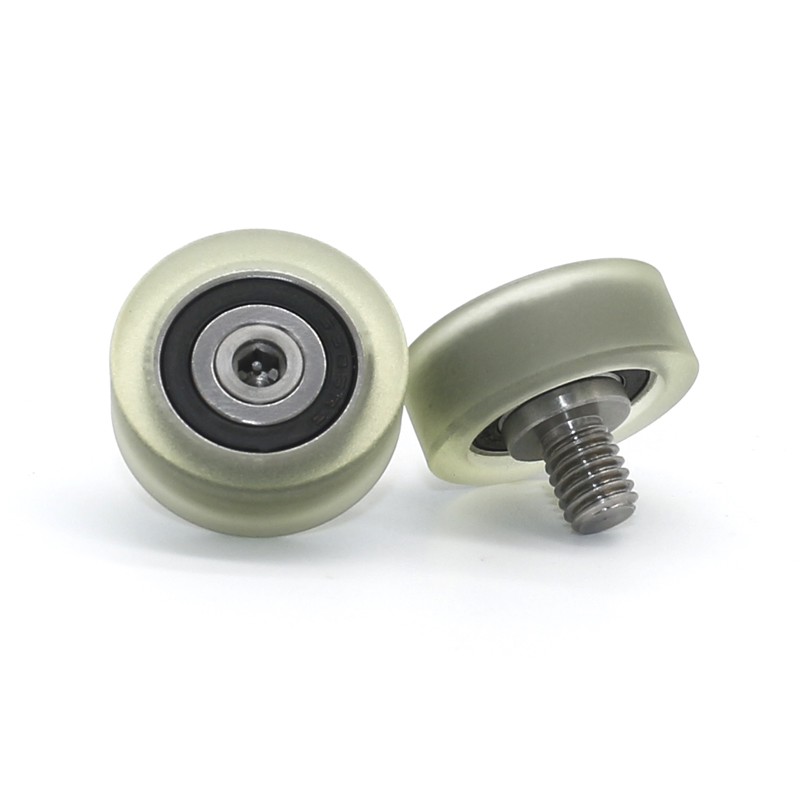
Let's talk about some specific products. We offer a wide range of urethane drive rollers, such as the Polyurethane Coated Roller Bearing S625RS. This roller is designed with high - quality urethane coating, which takes full advantage of the viscoelastic properties. It's great for applications where precise movement and shock absorption are required.
The Conveyor Belt BearingsS683ZZ are also a popular choice. These bearings are used in conveyor systems, and the viscoelastic urethane helps in smooth operation, reducing noise and vibration. They can handle heavy loads while maintaining their shape and performance over time.
And then there's the Polyurethane Coated Pulley Bearing 605RS. This pulley bearing is ideal for applications where there's a need for both traction and flexibility. The viscoelastic urethane coating ensures that the pulley can adapt to different operating conditions, providing reliable performance.
Now, how does the viscoelasticity of urethane drive rollers change under different conditions? Temperature is a big factor. At lower temperatures, urethane becomes more rigid, and its viscoelastic response slows down. This means it may take longer for the roller to return to its original shape after deformation. On the other hand, at higher temperatures, urethane becomes softer, and its viscous behavior becomes more pronounced. So, when selecting urethane drive rollers, it's important to consider the operating temperature range.
The load also affects the viscoelasticity. Higher loads will cause more deformation, and the time it takes for the roller to recover may increase. However, urethane is known for its ability to withstand relatively high loads without permanent deformation, thanks to its viscoelastic properties.
In addition to temperature and load, the frequency of loading also matters. If the rollers are subjected to rapid and repeated loading, the viscoelastic response can change. For example, in high - speed conveyor systems, the rollers need to be able to respond quickly to the repeated impacts. Urethane drive rollers with the right formulation can handle these high - frequency loads effectively.
Maintenance is also an important aspect when it comes to urethane drive rollers. While the viscoelasticity gives them durability, proper maintenance can further extend their lifespan. Regular cleaning to remove debris and contaminants can prevent premature wear. Also, checking for signs of excessive deformation or damage can help catch any issues early on.
So, if you're in the market for urethane drive rollers, you're probably wondering how to choose the right ones. First, consider the application. What kind of loads will the rollers be subjected to? What's the operating temperature? How fast will the system be running? Based on these factors, you can select the appropriate type of urethane drive roller.
If you need a roller for a high - load, low - speed application, a more rigid urethane formulation might be suitable. For high - speed, low - load applications, a softer urethane that can respond quickly to deformation could be the better choice. And if your application involves a wide range of temperatures, you'll want to look for a urethane that has good temperature resistance.
As a supplier, we understand that every customer's needs are different. That's why we offer a variety of urethane drive rollers with different viscoelastic properties to meet your specific requirements. Whether you're in the manufacturing, logistics, or any other industry that uses conveyor systems or drive mechanisms, we've got the right solution for you.
If you're interested in learning more about our urethane drive rollers or have any questions about their viscoelasticity and how it can benefit your application, don't hesitate to get in touch. We're here to help you make the best choice for your business. Let's start a conversation about how our urethane drive rollers can improve your operations.
References

- ASTM International. (2023). Standards related to polyurethane materials.
- Engineering Handbook of Polymer Science. (2022). Chapter on viscoelastic polymers.


