


Hey there! As a supplier of U groove pulleys, I've been getting a lot of questions lately about how pulley speed affects power transmission efficiency in a U groove pulley system. So, I thought I'd take a deep dive into this topic and share what I've learned over the years.
First off, let's talk about what a U groove pulley system is. It's a simple yet effective mechanism that uses pulleys with a U - shaped groove to transmit power from one point to another. These pulleys are commonly used in various applications, like sliding doors, conveyor belts, and even some industrial machinery. And that's where my products come in! We offer a wide range of U groove pulleys, including the Sliding Door U Groove Rubber Pulley and the S626RS Bearing Pulley, which are designed to meet different needs.
Now, back to the main question: what's the effect of pulley speed on power transmission efficiency? Well, it's a bit of a complex relationship, and there are several factors at play.
One of the most significant factors is friction. At low speeds, the friction between the belt and the U groove pulley is relatively stable. The belt can grip the pulley well, and most of the power is transferred effectively. However, as the speed increases, things start to get a bit tricky. Higher speeds can cause the belt to heat up due to increased friction. This heat can lead to a decrease in the belt's elasticity, which in turn reduces its ability to grip the pulley properly. When the belt slips on the pulley, power is lost, and the efficiency of the system drops.
Another aspect to consider is the centrifugal force. As the pulley spins faster, the centrifugal force acting on the belt increases. This force tends to push the belt away from the pulley, reducing the contact area between the belt and the pulley. With less contact, the grip is weakened, and more power is wasted in overcoming the slipping. So, in a way, high - speed operation can be a double - edged sword when it comes to power transmission efficiency.
The material of the pulley and the belt also plays a crucial role. For example, our Sliding Door U Groove Rubber Pulley has a rubber surface, which provides good grip at moderate speeds. But at very high speeds, the rubber can wear out faster due to the increased friction and heat. On the other hand, pulleys with a more durable material like metal may be better suited for high - speed applications, but they also need to be properly lubricated to reduce friction.
Let's take a look at some real - world scenarios. In a conveyor belt system, if the pulley speed is too high, the items on the belt may not be transported smoothly. The belt might slip, causing the items to jolt or even fall off. This not only affects the efficiency of the power transmission but also the overall productivity of the system. In a sliding door application, a high - speed pulley operation can lead to noisy and jerky movements, which is definitely not what you want.

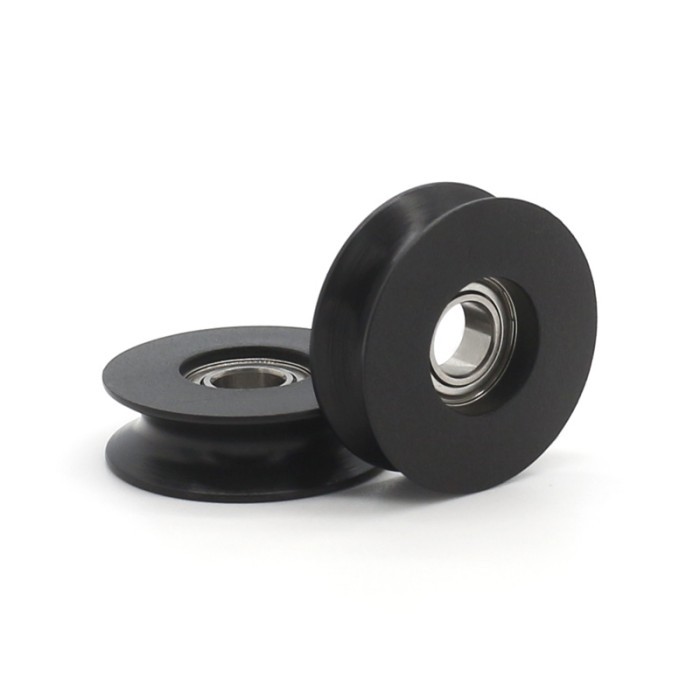
So, how can we optimize the power transmission efficiency in a U groove pulley system with different speeds? Well, one way is to choose the right pulley and belt combination. For low - speed applications, a rubber - coated pulley like our Sliding Door U Groove Rubber Pulley can be a great choice. It provides excellent grip and is relatively quiet. For high - speed applications, a pulley with a metal surface and high - quality bearings, such as the S626RS Bearing Pulley, can handle the stress better.
Proper maintenance is also key. Regularly checking the tension of the belt, lubricating the pulleys, and inspecting for signs of wear can go a long way in ensuring optimal efficiency. If the belt is too loose, it's more likely to slip, especially at high speeds. If it's too tight, it can put extra stress on the pulleys and bearings, leading to premature failure.
In addition, using a speed - control mechanism can be very beneficial. By adjusting the speed according to the load and the requirements of the system, you can avoid running the pulleys at speeds that are too high or too low. This helps to maintain a good balance between power transmission efficiency and the longevity of the components.
To sum it up, the speed of the pulley in a U groove pulley system has a significant impact on power transmission efficiency. Low speeds generally offer better grip and less power loss due to friction and centrifugal force. However, as the speed increases, the efficiency can decline due to factors like belt slipping, heat generation, and reduced contact area. By choosing the right components, performing regular maintenance, and using speed - control methods, we can optimize the performance of the system.
If you're in the market for U groove pulleys or have any questions about power transmission efficiency in your pulley system, don't hesitate to reach out. We're here to help you find the best solutions for your specific needs. Whether it's for a small sliding door project or a large - scale industrial application, we've got the products and the expertise to make your system work at its best.
References
- Norton, Robert L. "Machine Design: An Integrated Approach." Pearson, 2012.
- Shigley, Joseph E., and Charles R. Mischke. "Mechanical Engineering Design." McGraw - Hill, 2003.


