


As a supplier of U groove pulleys, I've had the privilege of witnessing the diverse applications and importance of these components in various mechanical systems. One of the common questions that arises in the field is how to calculate the speed reduction using a U groove pulley. In this blog, I'll guide you through the process, step by step, and also highlight the significance of choosing the right U groove pulley for your specific needs.
Understanding the Basics of U Groove Pulleys
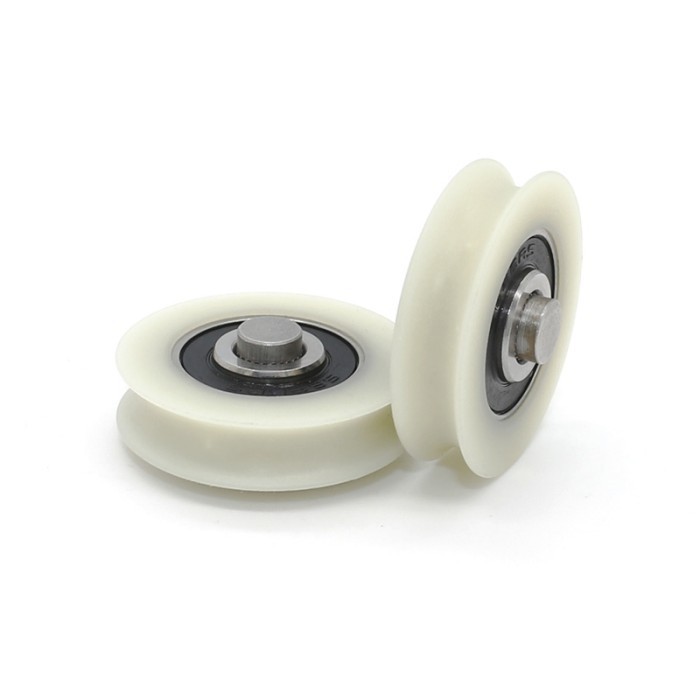
U groove pulleys are designed with a U - shaped groove that is used to guide and transmit power through a belt or a rope. They are widely used in applications such as sliding doors, conveyor systems, and various types of machinery. The unique shape of the U groove helps to keep the belt or rope in place, ensuring efficient power transmission.
There are different types of U groove pulleys available in the market. For instance, the S626RS Bearing Pulley is a popular choice for applications that require smooth and reliable operation. It comes with a high - quality bearing that reduces friction and extends the lifespan of the pulley. Another option is the Sliding Door U Groove Rubber Pulley, which is specifically designed for sliding door systems. The rubber coating provides better grip and reduces noise during operation.
The Principle of Speed Reduction with U Groove Pulleys
The concept of speed reduction using U groove pulleys is based on the relationship between the diameters of the driving pulley and the driven pulley. When two pulleys are connected by a belt, the speed ratio between them is determined by the ratio of their diameters.

Let's assume we have a driving pulley with a diameter (D_1) and a driven pulley with a diameter (D_2). The speed of the driving pulley is (N_1) (in revolutions per minute, RPM), and the speed of the driven pulley is (N_2). The relationship between these variables is given by the following formula:
(\frac{N_1}{N_2}=\frac{D_2}{D_1})
This formula shows that if the diameter of the driven pulley ((D_2)) is larger than the diameter of the driving pulley ((D_1)), the speed of the driven pulley ((N_2)) will be lower than the speed of the driving pulley ((N_1)). In other words, we achieve speed reduction.
Step - by - Step Calculation of Speed Reduction
- Measure the Diameters of the Pulleys: The first step in calculating the speed reduction is to accurately measure the diameters of the driving and driven pulleys. Use a caliper or a measuring tape to get the most precise measurements. Make sure to measure the diameter at the point where the belt makes contact with the pulley.
- Determine the Speed of the Driving Pulley: You need to know the speed of the driving pulley, which is usually provided by the motor or the power source. If the speed is given in a different unit, convert it to RPM.
- Apply the Speed Ratio Formula: Once you have the diameters of the pulleys ((D_1) and (D_2)) and the speed of the driving pulley ((N_1)), you can use the formula (\frac{N_1}{N_2}=\frac{D_2}{D_1}) to calculate the speed of the driven pulley ((N_2)). Rearranging the formula to solve for (N_2), we get (N_2 = N_1\times\frac{D_1}{D_2})
For example, if the diameter of the driving pulley (D_1 = 50) mm, the diameter of the driven pulley (D_2 = 100) mm, and the speed of the driving pulley (N_1 = 1000) RPM. Then, using the formula (N_2 = N_1\times\frac{D_1}{D_2}), we have (N_2=1000\times\frac{50}{100}=500) RPM. The speed reduction in this case is from 1000 RPM to 500 RPM, which is a 50% reduction.
Factors Affecting Speed Reduction Calculation
While the basic formula for speed reduction is straightforward, there are several factors that can affect the accuracy of the calculation.
- Belt Slip: In real - world applications, belt slip can occur, especially if the belt is not properly tensioned or if there is excessive load on the system. Belt slip can cause the actual speed of the driven pulley to be lower than the calculated speed. To minimize belt slip, make sure to choose the right belt material and tension it correctly.
- Pulley Tolerances: The manufacturing tolerances of the pulleys can also affect the speed reduction calculation. Small variations in the diameter of the pulleys can lead to differences in the actual speed ratio. When selecting pulleys, choose high - quality products with tight tolerances to ensure accurate speed reduction.
- Friction and Bearing Losses: Friction in the bearings and between the belt and the pulley can cause energy losses, which can also affect the speed of the driven pulley. Using high - quality bearings and lubricating the system can help reduce these losses.
Choosing the Right U Groove Pulley for Speed Reduction
When selecting a U groove pulley for speed reduction, there are several factors to consider.
- Load Capacity: The pulley should be able to handle the load of the system. Consider the weight of the objects being moved, the tension in the belt, and any additional forces acting on the pulley.
- Speed Requirements: Based on the desired speed reduction, choose pulleys with appropriate diameters. Make sure that the speed of the driven pulley meets the requirements of the application.
- Material and Durability: The material of the pulley affects its durability and performance. Common materials include steel, aluminum, and plastic. Steel pulleys are strong and durable, while aluminum pulleys are lightweight. Plastic pulleys are often used in applications where noise reduction is important.
Conclusion
Calculating the speed reduction using a U groove pulley is a fundamental concept in mechanical engineering. By understanding the principle of speed ratio and following the step - by - step calculation process, you can accurately determine the speed of the driven pulley. However, it's important to consider the factors that can affect the calculation, such as belt slip, pulley tolerances, and friction losses.
As a U groove pulley supplier, I can offer a wide range of high - quality pulleys that are suitable for various applications. Whether you need a S626RS Bearing Pulley for a smooth - running system or a Sliding Door U Groove Rubber Pulley for a quiet operation, we have the right solution for you.
If you are interested in purchasing U groove pulleys for your speed reduction needs, I encourage you to get in touch with us for a detailed consultation. We can help you choose the most appropriate pulleys and provide you with all the necessary technical support.
References
- Norton, Robert L. "Machine Design: An Integrated Approach." Pearson, 2012.
- Shigley, Joseph E., and Charles R. Mischke. "Mechanical Engineering Design." McGraw - Hill, 2004.


