


Hey there! As a supplier of spherical plain bearings, I often get asked about the PTFE liner in these bearings and how it works. So, I thought I'd write a blog post to share some insights on this topic.
First off, let's talk a bit about spherical plain bearings. These are super useful components in all sorts of mechanical systems. They can handle both radial and axial loads and can accommodate angular misalignment between the shaft and the housing. This makes them perfect for applications like automotive suspension systems, industrial machinery, and aerospace equipment.
Now, the PTFE liner is a key part of many spherical plain bearings. PTFE, or polytetrafluoroethylene, is a synthetic fluoropolymer. You might know it better by the brand name Teflon. It's got some amazing properties that make it ideal for use in bearings.
One of the main features of PTFE is its low friction coefficient. This means that when the bearing is in operation, there's less resistance between the moving parts. Less friction translates to smoother movement, which is crucial for the efficient functioning of the machinery. For example, in an automotive suspension system, a spherical plain bearing with a PTFE liner allows the wheels to move up and down more freely, providing a better ride quality.
Another great thing about PTFE is its high chemical resistance. It can withstand exposure to a wide range of chemicals without getting damaged. This is really important in industrial settings where the bearings might come into contact with various lubricants, solvents, or corrosive substances. The PTFE liner acts as a protective barrier, ensuring the longevity of the bearing.
The PTFE liner also has excellent wear resistance. Over time, as the bearing moves and experiences loads, there's going to be some wear and tear. But the PTFE liner is tough enough to handle this. It can maintain its shape and integrity for a long time, reducing the need for frequent replacements. This not only saves money but also minimizes downtime in industrial operations.
In terms of how it works within the spherical plain bearing, the PTFE liner is usually bonded to the inner surface of the outer ring of the bearing. When the inner ring (the part that's attached to the shaft) moves relative to the outer ring, the PTFE liner provides a smooth sliding surface. The low - friction nature of PTFE allows the inner ring to move easily within the outer ring, even under heavy loads.
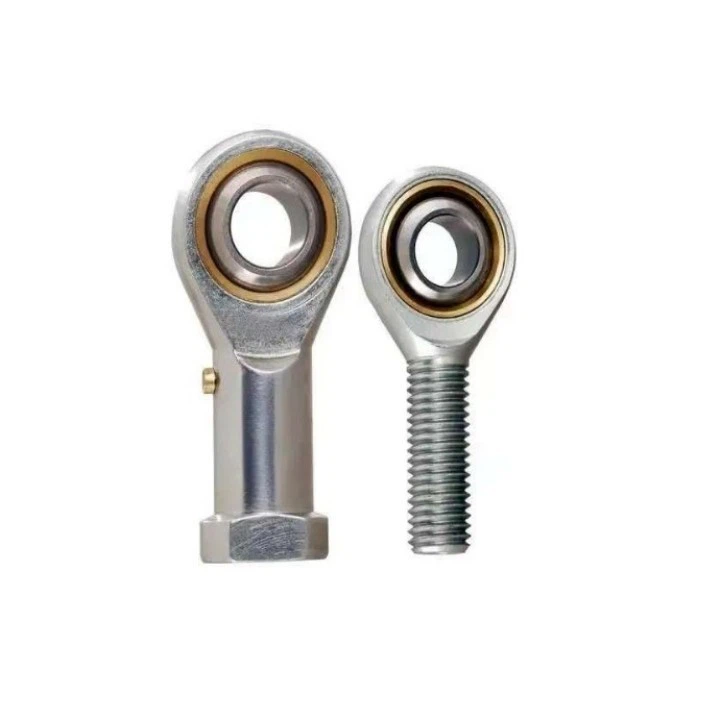
Let's take a quick look at some of our products that feature PTFE liners. We have the Stainless Steel Rod End Bearings SI5. These are made from high - quality stainless steel and have a PTFE liner that ensures smooth operation. They're great for applications where corrosion resistance is a must, like marine equipment.
Our Rod End Bearings SA8 also come with a PTFE liner. These bearings are designed to handle high radial loads and are commonly used in industrial machinery. The PTFE liner helps in reducing friction and wear, making them a reliable choice for long - term use.
And then there are the Stainless Steel Heim Joint Rod Ends SI8. These are similar to the SI5 but have a different design. They're often used in applications that require precise movement and alignment, such as in robotics. The PTFE liner in these bearings plays a crucial role in providing the necessary smoothness and accuracy.
When it comes to installation and maintenance, spherical plain bearings with PTFE liners are relatively easy to work with. However, it's important to follow the manufacturer's guidelines. During installation, make sure the bearing is properly aligned and that there are no contaminants on the PTFE liner. This can affect its performance.
In terms of maintenance, regular inspection is key. Check for signs of wear, such as excessive play or rough movement. If you notice any issues, it might be time to replace the bearing. But thanks to the PTFE liner, the intervals between replacements can be quite long.

Temperature is also an important factor to consider. PTFE has a relatively wide operating temperature range, but extreme temperatures can still affect its performance. In very high - temperature environments, the PTFE liner might expand or degrade, which could lead to reduced performance. Similarly, in very cold temperatures, it could become brittle. So, it's important to choose a bearing with a PTFE liner that's suitable for the operating temperature of your application.
So, to sum it all up, the PTFE liner in a spherical plain bearing is a game - changer. Its low friction, high chemical resistance, and wear resistance properties make it an essential component for smooth, efficient, and long - lasting bearing operation. Whether you're in the automotive, industrial, or aerospace industry, our bearings with PTFE liners can meet your needs.
If you're interested in any of our spherical plain bearings or want to learn more about how they can fit into your specific application, don't hesitate to get in touch. We're always here to help you choose the right product and answer any questions you might have.
References
- "Engineering Tribology" by Stachowiak and Batchelor
- "Handbook of Bearings" by various authors


